
Your attic shouldn't feel like a sauna that's slowly draining your bank account every time the North Carolina sun hits its peak. Many homeowners assume that uneven temperatures between floors are just part of life in Charlotte, but the reality often points to aging, inefficient, or pest-damaged material overhead. If you've been searching for blown in insulation near me to solve these frustrations, you're likely looking for more than just a quick fix. You want a permanent restoration of your home's comfort and a clean space you can trust.
We agree that your home should be a sanctuary where energy bills are manageable and the air is fresh. In this guide, you'll discover why blown-in fiberglass is the gold standard for our local climate and how a meticulous seal-then-insulate approach makes all the difference. We will explore the latest 2026 building code requirements, including the shift to R-49 standards, and explain why fiberglass is the superior choice over cellulose for long-term protection. From identifying mold risks to maximizing Duke Energy rebates, we'll provide the expert roadmap you need for a cooler, more efficient home.
Key Takeaways
- Learn why moisture-resistant fiberglass is the superior choice over cellulose for protecting your North Carolina home from mold and material settling.
- Discover why professional air sealing is the most critical first step to perform before any insulation is blown into your attic space.
- Find out how searching for blown in insulation near me can connect you with local craftsmen who prioritize your home's long-term comfort and air quality.
- Understand the impact of the 2026 North Carolina building code updates and how achieving an R-49 value can significantly reduce your HVAC runtime.
- Identify the specific red flags to watch for when hiring a contractor to ensure your attic project is managed with transparency and meticulous care.
What is Blown-In Insulation and Why Is It Trending in Charlotte?
Blown-in insulation is a loose-fill material that is professionally installed using a high-volume blower machine. Instead of carrying heavy, itchy rolls up a ladder, a technician uses a long, flexible hose to distribute fluffed fiberglass across the attic floor. This process creates a seamless thermal blanket that covers every inch of the space. In Charlotte's humid subtropical climate, your home's thermal envelope is its first line of defense. This envelope is the physical barrier between your air-conditioned rooms and the sweltering NC heat. When this barrier is weak, your cooling system works overtime to fight the humidity creeping through your ceiling.
In 2026, we are seeing a significant shift toward this method because it offers a level of precision that older techniques simply can't match. As local energy standards evolve, homeowners are looking for ways to achieve higher R-values without a massive renovation. Blown-in fiberglass provides a dense, consistent layer of protection that keeps your home's temperature stable, regardless of how high the thermometer climbs in the Queen City.
The Difference Between Batts and Blown-In
Traditional fiberglass batts are often compared to puzzle pieces. They are pre-cut sections that must be fitted between joists manually. While they have been a standard for decades, they almost always leave small gaps around wiring, plumbing stacks, and irregular corners. These tiny voids allow for convective heat loops, where warm air cycles through the gaps and bypasses your insulation entirely.
When you examine various building insulation materials, the advantage of a loose-fill "blanket" becomes clear. Blown-in material flows into every crevice, creating a monolithic layer that eliminates the gaps where heat escapes. This seamless coverage is why we consistently recommend blown-in fiberglass over traditional batts for attic applications. It doesn't just sit on the floor; it seals the floor, providing a much higher level of efficiency for every pound of material used.
Why 'Near Me' Searches Lead to Better Local Results
When you begin searching for blown in insulation near me, you're looking for more than a contractor; you're looking for a specialist who understands the Piedmont region's unique architecture. Charlotte homes often feature complex rooflines and crawlspaces that require a nuanced approach. A local expert knows exactly how our humidity affects material longevity and settles into the attic over time.
Choosing blown in insulation near me also means working with someone familiar with the latest 2026 North Carolina building codes. We prioritize fiberglass because it remains moisture-resistant and doesn't settle like cellulose, ensuring your R-value stays exactly where it needs to be for years to come. For a deeper look at local standards, you can review our Charlotte Attic Insulation Guide to see how we tailor every project to our local environment.
Fiberglass vs. Cellulose: Why Fiberglass Wins for NC Attics
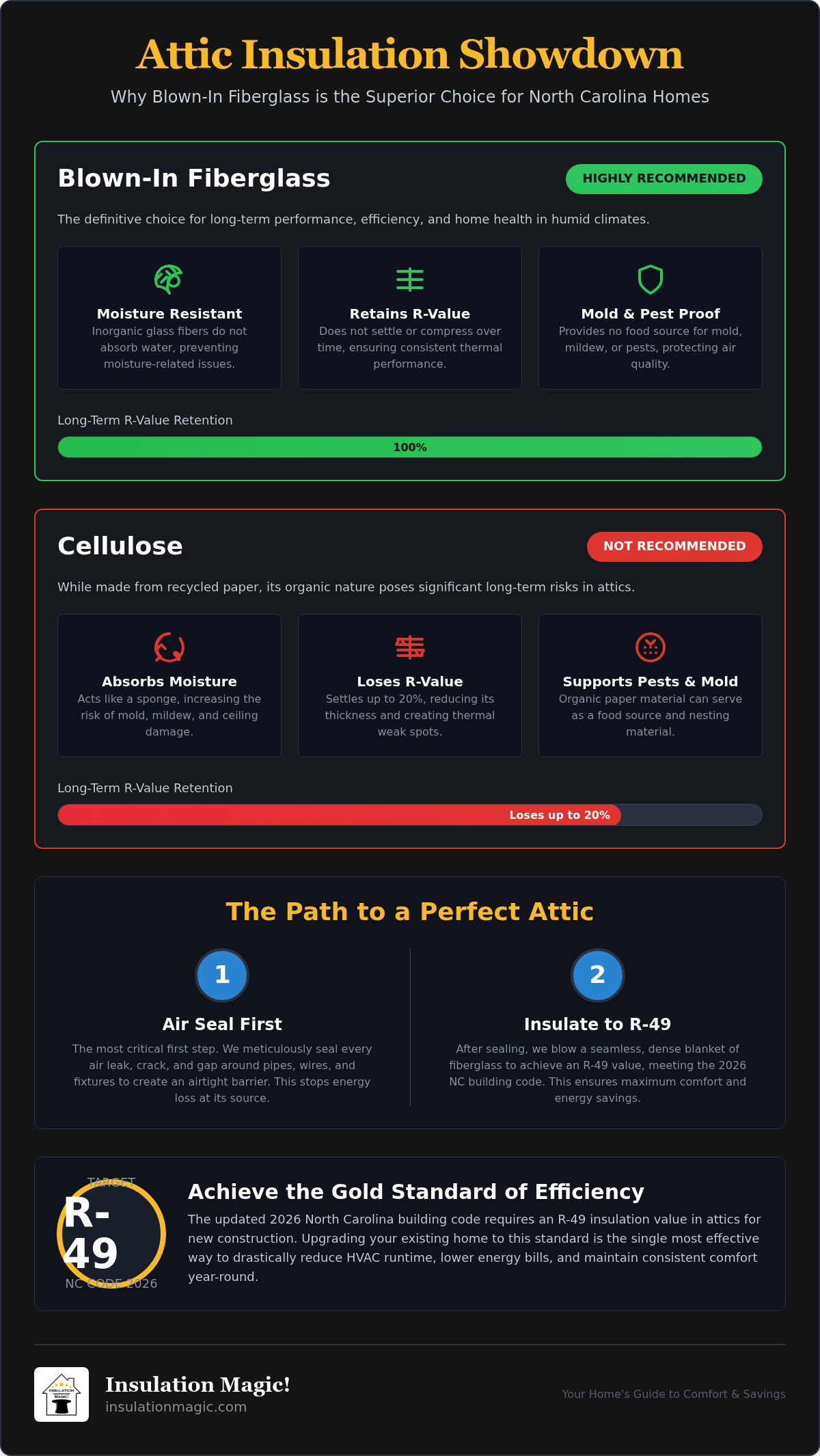
When homeowners start looking for blown in insulation near me, they often encounter a debate between fiberglass and cellulose. While some marketing materials focus heavily on the "recycled" nature of cellulose, we prioritize long-term performance and home health. In the humid environment of Charlotte, fiberglass is the clear winner for attic applications. It's an inorganic material that doesn't provide a food source for mold or pests, and it handles our local moisture levels without losing its integrity. While cellulose is made from paper, fiberglass is made from spun glass, making it naturally resistant to the elements that typically break down organic materials.
We often hear the argument that cellulose is more "eco-friendly" because of its recycled content. However, true energy savings come from a material that maintains its performance for the life of the home. If a material settles or degrades, the energy required to heat and cool your home increases, which offsets any initial environmental benefit from the manufacturing process. Choosing a material that stays in place and performs consistently is the most sustainable choice you can make for your property.
The Settling Factor: Long-Term R-Value
The most significant drawback of cellulose is its tendency to settle over time. Over the first few years, gravity and home vibrations cause cellulose to compress, which physically reduces the thickness of your thermal barrier. R-value is the measure of a material's thermal resistance. When your insulation loses height, it loses R-value, meaning you'll eventually need a "top-off" to maintain efficiency. In contrast, fiberglass remains stable for decades. It maintains its loft and trapped air pockets, ensuring the protection you pay for today is the same protection you have ten years from now. This reliability is one reason why insulation upgrades can pay for itself through consistent monthly utility savings.
Moisture, Mold, and Fire Retardants
North Carolina's humidity is a major factor in material choice. Cellulose is made from recycled paper, which is naturally organic and absorbent. To make it fire-resistant, manufacturers treat it with chemicals like boric acid. In a humid attic, that paper can soak up moisture, potentially leaching out those fire retardants over time and creating a damp environment where mold can thrive. Fiberglass is naturally non-combustible because it's made of glass. It doesn't need heavy chemical additives to stay safe, and it won't absorb water from the air. For families in Waxhaw and Matthews, this means a cleaner, safer attic space that won't require expensive remediation down the road.
If you're ready to see how a high-quality fiberglass installation can transform your home's comfort, you can book a professional attic assessment to get a clear picture of your current R-value and potential improvements.
The Meticulous Craftsman’s Process for Attic Installation
At Insulation Magic!, we believe that preparation is 90% of a successful project. Many homeowners searching for blown in insulation near me are surprised to learn that the actual "blowing" of the material is the final, shortest step of our day. Before we bring a single hose into your home, we treat your property with the same care we'd give our own. This starts with laying floor runners and setting up dust containment barriers to ensure your living space remains pristine. Our goal is to leave your home cleaner than we found it while providing a world-class attic upgrade that lasts for decades.
We don't just throw material over old problems. We take a methodical approach to assessing your attic's unique needs, identifying areas where previous contractors might have cut corners. By focusing on the underlying structure first, we ensure that your investment in fiberglass provides the maximum possible return in comfort and energy savings.
Step 1: The Critical Air Sealing Phase
Insulation alone won't stop air from leaking out of your home. If you have gaps around top plates, wire penetrations, or plumbing stacks, your expensive conditioned air is escaping directly into the attic. Think of it like wearing a high-quality wool sweater in a winter windstorm; without a windbreaker, the cold air cuts right through the fibers. Air sealing acts as that windbreaker. We meticulously hunt down these hidden leaks to ensure your new fiberglass blanket can do its job effectively. For a deeper look at this invisible secret, check out our Home Air Sealing Guide.
Step 2: Professional Blown-In Execution
Once the attic floor is sealed, we begin the professional installation. We calibrate our equipment specifically for the density and loft required to meet the 2026 North Carolina standards. This isn't a "one size fits all" task. We take the time to reach deep into eaves and tight corners where heat often accumulates, ensuring no "hot spots" are left behind.
A key part of finding the right blown in insulation near me is choosing a team that understands attic ventilation. We install baffles and soffit protection to ensure air still flows properly under the roof deck. This prevents moisture buildup and keeps your roof healthy while your home stays cool. To finish, we perform a final "blown-to-spec" verification, measuring the depth across the entire attic to guarantee you've received the full R-value promised for your project.
Calculating Your ROI: Energy Savings in the Charlotte Metro
Investing in your attic isn't just about comfort; it's a strategic financial move. When you search for blown in insulation near me, you're looking for a way to stop the monthly drain on your bank account. In the Charlotte area, properly insulating and air sealing a home can lead to a reduction in heating and cooling costs by up to 15%. Because North Carolina summers are notoriously intense, your HVAC system often bears the brunt of an under-insulated attic. By upgrading to fiberglass blown-in insulation, you're ensuring that your investment remains stable and effective for decades, unlike organic materials that settle and lose their thermal resistance over time.
Stopping the Summer Heat Soak
During a typical July afternoon in Mecklenburg County, attic temperatures can easily soar to 140 degrees. Without a sufficient thermal barrier, your attic acts like a giant radiator, beaming heat directly through your ceiling and into your living space. This is the primary cause of the "second floor heat" problem where upstairs bedrooms remain uncomfortably warm regardless of the AC setting. A thick layer of fiberglass prevents this heat transfer, allowing your cooling system to run shorter, more efficient cycles. This doesn't just lower your utility bills; it also extends the lifespan of your expensive HVAC equipment by reducing its daily workload.
Winter Benefits: Keeping the Heat Downstairs
While we focus on the heat, Charlotte's damp winters present their own challenges. Warm air naturally rises, creating a "stack effect" where the heat you pay for escapes through tiny gaps and thin insulation in your roof. By creating a seamless fiberglass blanket, we trap that warmth where it belongs. For more strategies on managing your home's efficiency year-round, you can read our guide on how to lower heating and cooling costs. This permanent solution ensures your home remains cozy without the furnace working double shifts.
In 2026, the financial case for attic upgrades is stronger than ever. The North Carolina Home Electrification and Appliance Rebates (HEAR) program currently offers up to $1,600 for insulation and weatherization projects. Additionally, Duke Energy continues to offer incentives through their Smart Saver program for customers who combine professional air sealing with insulation upgrades. With the 2026 building code moving toward a minimum R-49 requirement, documented attic improvements also provide a significant boost to home resale value in the competitive Charlotte real estate market. Buyers today look for energy-efficient homes that are ready for the future.
Choosing the Right Charlotte Insulation Contractor
Selecting a partner for your home improvement project is a decision that impacts your comfort for years. When you begin searching for blown in insulation near me, you'll likely encounter a wide range of quotes and promises. It is vital to recognize that a low-ball price often signals that a contractor is cutting corners, most commonly by skipping the air sealing phase. As a specialist, Chris at Insulation Magic! understands that insulation is only half the battle. If a company doesn't mention sealing top plates or wire penetrations, they're leaving your home's thermal envelope incomplete.
Choosing an independent, owner-operated business offers a level of accountability that corporate franchises simply can't match. We don't view your home as just another ticket on a schedule. Instead, we approach every project with a "Meticulous Craftsman" mindset, treating your attic as if it were our own. This dedication to quality is a recurring theme in Insulation Magic! reviews, where homeowners frequently highlight our transparency and the thoroughness of our cleanup process. By focusing exclusively on attic and crawlspace environments, we provide a level of expertise that "jack-of-all-trades" contractors often lack.
Questions to Ask Your Insulation Pro
Before you sign a contract, we encourage you to act as an informed advocate for your home. A "Patient Educator" will always be happy to answer these questions:
- Do you include air sealing in your standard quote? If the answer is no, the insulation won't perform at its rated R-value.
- Will you be using fiberglass or cellulose, and why? We strictly recommend fiberglass because it doesn't settle like cellulose and remains moisture-resistant in our humid climate.
- How do you ensure my home stays clean? Ask about floor runners, dust containment, and their specific cleanup protocol.
The Insulation Magic! Guarantee
Our commitment to Waxhaw and Ballantyne families is built on integrity and education. We don't just perform a task; we explain the "how" and "why" behind every step of our process. From the initial assessment to the final verification, you'll know exactly how your home's efficiency is being improved. We take immense pride in our work and the long-term relationships we build with our neighbors. If you're ready for a cleaner, more comfortable home, you can easily access a professional quote and online booking through our website. Let's work together to make your attic a source of savings rather than a source of stress.
Reclaim Your Home’s Comfort and Efficiency
Your attic shouldn't be a source of stress or high utility bills. By choosing moisture-resistant fiberglass and prioritizing professional air sealing, you're investing in a permanent solution that protects your home's thermal envelope. This meticulous approach ensures consistent temperatures across all floors while lowering your HVAC runtime during our intense North Carolina summers. We specialize in fiberglass and air sealing; we never use spray foam. You can trust our local, independent team to treat your property with the care it deserves. Feel free to check out our 5-star Charlotte homeowner reviews to see how we've helped your neighbors in Waxhaw and Matthews. Searching for blown in insulation near me is the first step toward reclaiming your home's comfort and air quality. We are here to guide you through the process, from demystifying R-values to maximizing your 2026 Duke Energy rebates. It's time to enjoy a cooler, cleaner, and more efficient home.
We look forward to helping you breathe easier and save more on your monthly energy costs. Your path to a better attic starts with a simple, expert conversation. Let's make your home the sanctuary it was meant to be.
Frequently Asked Questions
Is blown-in insulation better than batts for an existing attic?
Blown-in insulation is generally superior to batts for existing attics because it creates a monolithic, seamless thermal blanket. While batts must be cut to fit around joists and wires, blown-in material flows into every crevice to eliminate gaps. This coverage is essential for stopping convective heat loops that often bypass traditional fiberglass batts. For homeowners seeking blown in insulation near me, this method offers the most consistent protection against the intense Charlotte humidity.
How much does blown-in insulation cost for a typical Charlotte home?
The cost of an attic upgrade in the Charlotte metro varies based on your attic's square footage and the current R-value of your existing material. Factors such as the complexity of your roofline and the amount of professional air sealing required will influence the final investment. We focus on providing long-term value through meticulous preparation; ensuring your project qualifies for available Duke Energy rebates to help offset the initial cost of your efficiency improvements.
Can you blow new insulation over old, existing insulation?
You can often blow new fiberglass over existing insulation if the old material is dry and free of contaminants. This "cap" effectively increases your home's thermal resistance without the need for a full removal. However, we always perform a thorough assessment first to ensure there is no hidden mold, moisture damage, or rodent activity. If the existing material is compromised, we recommend our professional insulation removal service to ensure a clean, healthy environment for your family.
What is the recommended R-value for attics in North Carolina?
For optimal performance in Charlotte's climate, an R-value between R-49 and R-60 is recommended. While the 2018 North Carolina State Building Code required a minimum of R-38, the updated 2024 code taking effect in mid-2026 increases this requirement to R-49 for many homes. Achieving these higher levels is the best way to manage the second floor heat problem and ensure your home remains comfortable during both damp winters and sweltering summers.
How long does the professional blown-in installation process take?
A professional installation typically takes one full day to complete, depending on the size of your attic and the amount of preparation required. The majority of this time is spent on the critical air sealing phase and protecting your home's interior. The actual process of distributing the blown-in fiberglass is efficient, but we never rush the meticulous prep work that ensures your new insulation performs at its maximum rated capacity for decades.
Will blown-in insulation make a mess in my living area?
We take extensive precautions to ensure your living area remains pristine throughout the project. Our team uses floor runners and specialized dust containment barriers to protect your carpet and furniture. Because we use a high-volume blower machine with a long, flexible hose, the material stays contained within the attic space. We treat every home with the same level of care we'd apply to our own property, leaving your space clean and restored.
Why do you recommend fiberglass over cellulose for attics?
We strictly recommend fiberglass because it is an inorganic, moisture-resistant material that does not settle over time. Unlike cellulose, which is made from recycled paper and can absorb attic humidity, fiberglass maintains its loft and R-value for the life of the home. It is naturally non-combustible and doesn't provide a food source for mold or pests. This makes it the cleaner, more reliable choice for families in Waxhaw, Matthews, and the surrounding Charlotte area.
Do I need to remove my old insulation before adding blown-in?
Removal is not always necessary, but it is highly recommended if your current insulation is moldy, wet, or has been infested by rodents. If your old material is simply thin but otherwise clean, we can often perform professional air sealing and then add a new layer of blown in insulation near me to reach modern R-49 standards. During our initial attic assessment, we'll educate you on the condition of your existing material so you can make an informed decision.
Disclaimer
This blog is intended to provide general information about insulation, energy efficiency, and home comfort based on years of experience. While we strive to keep content accurate and up to date, results may vary based on your home's construction, condition, and climate. Contact Insulation Magic for a personalized assessment and recommendations.


