If you live in Charlotte, you know the feeling. It’s a sweltering July afternoon, the air is thick with humidity, and your air conditioner has been running nonstop for hours. Yet, your second floor feels like a sauna. This frustrating and expensive problem, often called "hot second floor syndrome," isn't a sign of a failing HVAC system. It’s a clear signal that your home's primary defense against the North Carolina sun—your attic insulation—is failing.
Many homeowners believe they just need to "top up" their existing insulation, but the reality is more complex. True comfort and energy savings in the Charlotte climate depend on a complete system. Discover how eliminating hidden air leaks and installing the right type of high-performance insulation can transform your home, slash your Duke Energy bills, and finally make every room comfortable, year-round.
Why Your Charlotte Home’s Second Floor Stays Hot (and How Attic Insulation Fixes It)
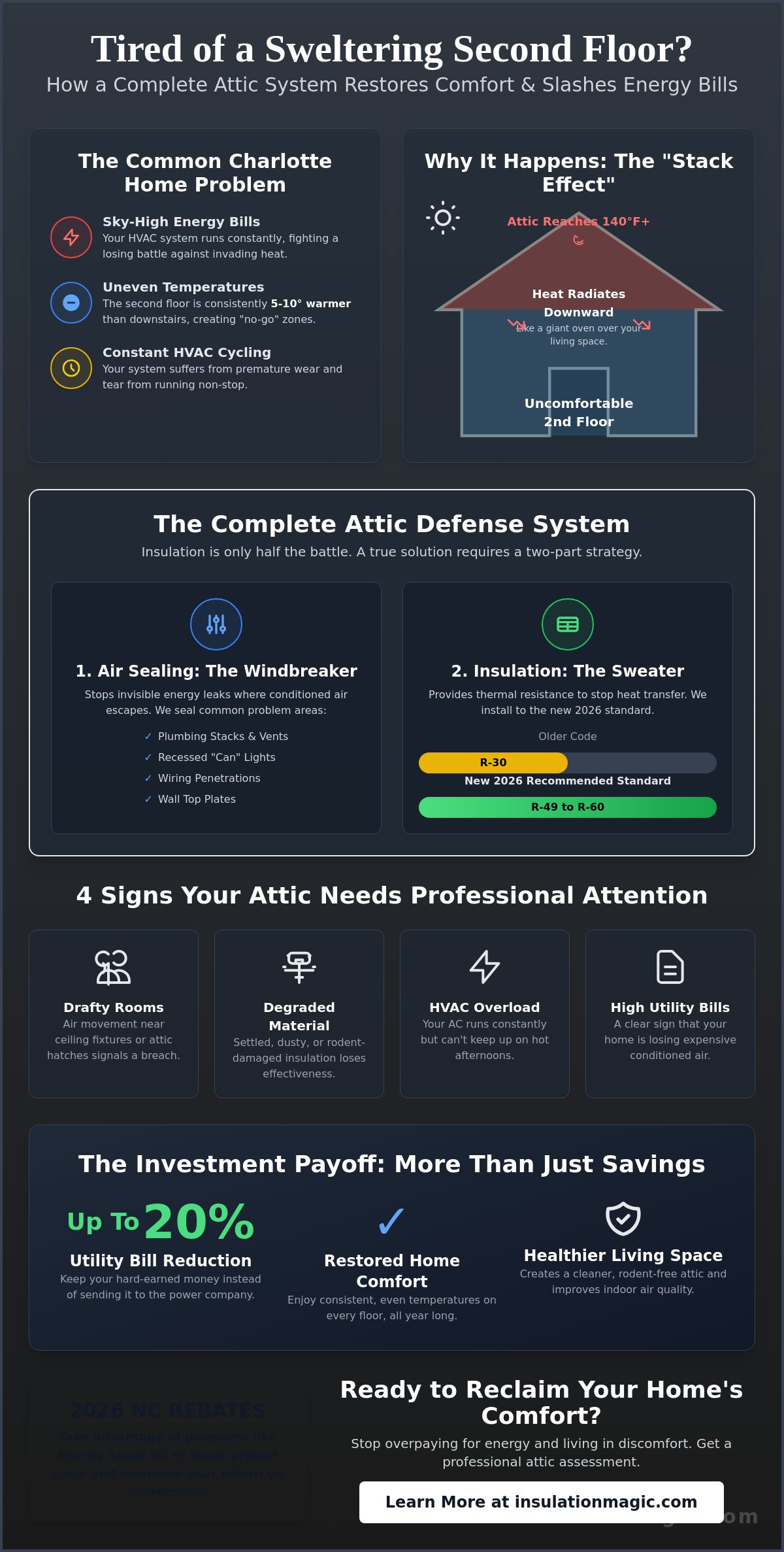
Your attic is the buffer zone between the sun-baked roof and your living space. When it isn't properly insulated and sealed, it becomes a giant radiator, transferring intense heat downward and making your upstairs rooms unbearable. This happens due to a combination of powerful thermal dynamics at play in most multi-story Charlotte homes.
- Radiant Heat Transfer: On a sunny day, your roof can reach temperatures of 150°F or more. This heat radiates downward, passing through inadequate insulation and heating up your attic floor (the ceiling of your second story). This is why your upstairs ceilings can feel warm to the touch.
- The Stack Effect: Heat naturally rises. In your home, cool, conditioned air from your HVAC system sinks, while warmer air rises. This process creates a convection current that pulls hot, humid air from the lower levels and pushes it upstairs. When it reaches the second floor, it gets trapped against the hot ceiling, creating a stifling environment your AC can't overcome.
- A Failed Thermal Barrier: Effective attic insulation is designed to be a complete thermal barrier, resisting the flow of heat. When insulation is old, compressed, or missing in spots, this barrier is compromised, creating easy pathways for heat to infiltrate your home.
The Charlotte Climate Factor: Humidity and Heat
The Queen City's climate presents a unique challenge. It’s not just the high temperatures; it's the relentless humidity that makes our summers so oppressive. This combination has a significant impact on your attic's performance.
- From Attic to Oven: A 90°F day can easily turn a poorly ventilated and under-insulated attic into a 140°F oven. This extreme heat puts immense strain on your air conditioner, forcing it to run constantly just to keep up.
- Humidity's Impact: High humidity can reduce the effectiveness of certain insulation materials, particularly older types that can absorb and trap moisture. This can lead to compaction, loss of R-value, and even create conditions for mold and mildew growth.
- Why "Code Minimum" Isn't Enough: While building codes specify a minimum amount of insulation, this is not the same as an optimal amount. For the sustained heat and humidity we experience in Charlotte, "just enough" insulation is rarely sufficient to achieve true comfort and energy efficiency.
Common Signs Your Attic Needs Professional Attention
How do you know if your attic is the culprit behind your discomfort and high bills? Look for these tell-tale signs:
- Uneven Temperatures: A significant temperature difference between your first and second floors is the most common symptom of an attic insulation problem. *Constant HVAC Operation: Your air conditioner or furnace runs for long cycles but struggles to reach the temperature set on your thermostat.
- High Energy Bills: A sudden spike or consistently high summer cooling costs from Duke Energy often points directly to heat gain from the attic.
- Visible Insulation Issues: A quick peek into your attic may reveal insulation that is settled below the ceiling joists, looks dusty and dirty, or shows signs of nesting from rodents or other pests.
Understanding R-Value and the Critical Role of Air Sealing in 2026
When discussing insulation, the term "R-value" is paramount. Simply put, R-value is the measure of a material's ability to resist heat flow. The higher the R-value, the better it insulates. For the Charlotte, NC climate (located in Climate Zone 3/4), the Department of Energy recommends an attic R-value between R-49 and R-60 for optimal performance.
However, R-value alone is only half of the equation. Piling on new insulation without addressing air leaks is like wearing a thick wool sweater full of holes on a windy day. The sweater itself is warm, but the cold air blowing through the gaps completely negates its effectiveness. This is the "Sweater in a Breeze" analogy, and it perfectly illustrates why air sealing is the most critical first step in any attic insulation project.
Your attic floor is likely full of small, invisible gaps and cracks around light fixtures, plumbing pipes, electrical wires, and the framing of your walls. These gaps create a direct path for your expensive conditioned air to escape into the attic, a phenomenon known as thermal bypass.
Why Air Sealing is the Secret to Attic Efficiency
Air sealing is the meticulous process of finding and closing every one of these thermal bypasses before any insulation is installed. It is the foundational step that makes the insulation work as intended, effectively creating an airtight seal between your living space and the attic.
- Stopping Conditioned Air Loss: By sealing these gaps with specialized, fire-rated sealants, we stop the upward flow of conditioned air, keeping it inside your home where it belongs.
- Improving Indoor Air Quality: Air sealing does more than just save energy. It prevents dusty, allergen-filled attic air from being pulled down into your living space, contributing to a cleaner, healthier home environment.
- Creating a Complete Thermal Envelope: The combination of professional air sealing and high-performance insulation creates a complete, unbroken thermal envelope. This system works together to keep summer heat out and winter heat in, dramatically improving comfort and reducing the workload on your HVAC system.
Calculating Your Current R-Value
Wondering where your home stands? You can get a rough estimate of your current R-value with a simple measurement. Safely look into your attic and use a tape measure to check the depth of your existing insulation. Most traditional loose-fill insulation provides an R-value of approximately R-2.5 to R-3.5 per inch of depth. If you have only 10 inches of insulation, your R-value could be as low as R-25—less than half of what is recommended for our climate. This is especially true for older insulation that has settled and compacted over time, losing much of its original insulating power.
Comparing Attic Insulation Materials: Why We Prioritize Safety and Breathability
When choosing an insulation material, homeowners in Charlotte have several options. While each has its place, we believe in providing solutions that offer the best long-term performance, safety, and value. That's why we have a clear philosophy: we prioritize high-performance traditional materials and do not use spray foam in existing homes.
Here’s a look at the most common materials:
- Blown-in Fiberglass: A premium, modern material made from fine strands of glass. It is naturally non-combustible, resistant to moisture and mold, and will not settle over time, ensuring it maintains its full R-value for the life of your home.
- Blown-in Cellulose: Made from recycled paper products treated with a fire retardant. It is an effective insulator and a good eco-friendly option, but can be prone to settling over time and is more susceptible to moisture absorption than fiberglass.
- Spray Foam: A chemical-based product that expands to fill cavities. While it provides both an air seal and insulation, its application in existing homes carries significant risks that we find unacceptable.
The Case Against Spray Foam in Existing Homes
While spray foam has its applications in new construction, we believe it is the wrong choice for retrofitting an existing attic. Our "No Spray Foam" stance is rooted in protecting your home's health and structural integrity.
- Chemical Off-Gassing: Spray foam is created through a chemical reaction that can sometimes release volatile organic compounds (VOCs) into the home if not mixed and cured perfectly.
- Trapped Moisture and Hidden Leaks: Because closed-cell spray foam is a vapor barrier, it can trap moisture against your roof decking. This prevents you from seeing a small roof leak until it has caused significant, hidden rot and structural damage.
- Permanent and Irreversible: Once applied, spray foam is virtually impossible to remove without damaging the underlying structure. This makes future roof repairs or electrical work incredibly difficult and expensive. Traditional materials, in contrast, are easily moved and replaced.
Blown-in Fiberglass: The Premium Choice for Modern Homes
For Charlotte's hot and humid climate, we recommend premium blown-in fiberglass insulation. Modern fiberglass has evolved significantly from the itchy pink batts of the past. It is a sophisticated, high-performance product that offers superior, lasting benefits.
- Superior Moisture Resistance: Fiberglass does not absorb water, making it inherently resistant to mold and mildew growth—a critical advantage in the humid Southeast.
- Guaranteed R-Value: Unlike cellulose, which can settle and compact over decades, blown-in fiberglass is incredibly lightweight and resilient. It holds its shape and loft, ensuring you get the full R-value you paid for, for life.
- Naturally Non-Combustible: Made from sand and recycled glass, fiberglass is naturally fire-resistant and does not require the addition of flame-retardant chemicals to achieve its safety rating.
- Clean and Lightweight: It’s a clean material that doesn't produce the same level of dust as cellulose, and its light weight puts minimal stress on your ceiling drywall.
The Insulation Magic! Process: Professional Removal and Meticulous Installation
Achieving a truly comfortable and energy-efficient home requires more than just blowing in some new material. It demands a meticulous, craftsman-led process that addresses the attic as a complete system. We treat your home with the utmost respect, ensuring a clean, safe, and seamless project from start to finish.
Step 1: Professional Removal and Sanitization
In many cases, especially in older homes, the first step is to remove the old, contaminated, and underperforming insulation. This creates a clean slate for a perfect installation.
- We use specialized, high-powered vacuums with long hoses that run to the outside of your home, ensuring no dust or debris enters your living space.
- This process safely removes decades of accumulated dust, allergens, and any hazardous materials from rodent or pest infestations.
- With the attic floor cleared, we can properly sanitize the area and gain unobstructed access to every gap and crack that needs to be sealed.
Step 2: Precision Air Sealing and Baffle Installation
This is the most critical stage, where we meticulously seal the thermal envelope. It’s detailed work that makes all the difference.
- Our technicians identify and seal every penetration point, including around plumbing stacks, electrical wires, recessed can lights, and the top plates of your interior walls.
- We install soffit baffles to ensure that the new insulation doesn't block airflow from your soffit vents. Proper attic ventilation is crucial for managing heat and moisture.
- We build protective dams around heat-producing fixtures to prevent any contact with the new insulation, ensuring safety and code compliance.
Step 3: Premium Blown-in Fiberglass Installation
Once the attic is fully prepped and sealed, we install a seamless blanket of premium blown-in fiberglass insulation.
- We calibrate our professional-grade blowing machine to achieve the precise density required for your target R-value (R-49 to R-60).
- Our team ensures an even, consistent depth of insulation across the entire attic floor, from the center all the way to the tight eaves.
- To complete the system, we install a specialized insulated cover for your attic hatch or pull-down stairs, sealing one of the largest sources of air leakage.
Maximizing Your Investment: Costs, Rebates, and Local Charlotte ROI
Upgrading your attic insulation is not just an expense; it's one of the smartest investments you can make in your home. The return on investment (ROI) comes in multiple forms: immediate energy savings, improved comfort, and increased long-term home value.
Charlotte homeowners who properly air seal and insulate their attics can often see a reduction of 15-20% or more on their heating and cooling costs. By reducing the intense heat load from the attic, you also extend the lifespan of your expensive HVAC system, which no longer has to run constantly to fight a losing battle.
When evaluating a quote, it's crucial to look beyond the bottom-line price. A low bid often means skipping the critical air sealing step or using less material than required to achieve the target R-value. A quality proposal will detail the entire process, including removal, air sealing, ventilation checks, and the final installed R-value.
Duke Energy Rebates and Incentives
Your investment can be even more affordable thanks to local utility programs. Duke Energy often offers rebates and incentives for homeowners who make energy-efficiency improvements like adding insulation and air sealing. These programs change, so it's important to check their website for the latest details on their Smart Saver® program. Using a qualified professional like Insulation Magic! can help ensure your project meets all the requirements for rebate eligibility.
Long-Term Value: Comfort, Resale, and Protection
The benefits of a properly insulated attic extend for years. A home with a documented, high-performance insulation system is more attractive to potential buyers in the competitive Charlotte real estate market. But perhaps the most significant return is the immediate and daily improvement in your quality of life. The "peace of mind" that comes from a comfortable, quiet, and energy-efficient home is priceless. You're not just buying insulation; you're investing in a healthier, more comfortable living environment for your family.
Ready to solve your hot second floor problem for good? Schedule your free, meticulous attic assessment with Insulation Magic! today!
Frequently Asked Questions About Attic Insulation
- How much attic insulation do I need in Charlotte, NC?
- For the Charlotte area, the U.S. Department of Energy recommends an R-value between R-49 and R-60. This typically translates to about 16 to 20 inches of modern blown-in fiberglass insulation.
- Is it worth removing old attic insulation before adding new?
- Yes, in many cases. If your old insulation is contaminated by pests, damaged by moisture, or is a low-quality material that has severely compacted, removal is highly recommended. It allows for proper air sealing and ensures the best performance from the new insulation.
- Can I stay in my home during the insulation installation?
- Absolutely. Our process is designed to be as non-intrusive as possible. All heavy equipment remains outside the home, and we take extensive measures to protect your property and contain any dust, ensuring your living space remains clean.
- How long does it take for attic insulation to pay for itself in energy savings?
- While it varies based on your home and energy habits, many homeowners see a payback period of 3-5 years through lower utility bills. Factoring in utility rebates can shorten this period even further.
- Why do you recommend fiberglass over cellulose for Charlotte attics?
- We recommend premium blown-in fiberglass because of its superior performance in our hot, humid climate. It is highly resistant to moisture and mold, it does not settle or lose R-value over time, and it is naturally non-combustible. It provides the most reliable, long-term value for Charlotte homeowners.
- What is the difference between air sealing and insulation?
- Air sealing stops air movement (drafts), while insulation slows heat transfer. You need both for a complete thermal barrier. Air sealing is the critical first step that makes insulation effective.
- Do I need an attic fan if I have new insulation?
- Not necessarily. With proper soffit and ridge ventilation, a well-sealed and fully insulated attic often performs better without a powered attic fan, which can sometimes depressurize the home and pull conditioned air up into the attic. We assess your ventilation as part of our process.
- How do I know if my attic insulation was installed correctly?
- A proper installation should show an even, consistent depth of insulation across the entire attic. There should be rulers installed to verify the depth, baffles at the eaves to protect ventilation, and dams around any heat-producing fixtures. A reputable contractor will provide photos and a clear explanation of the work performed.
Disclaimer
This blog is intended to provide general information about insulation, energy efficiency, and home comfort based on years of experience. While we strive to keep content accurate and up to date, results may vary based on your home's construction, condition, and climate. Contact Insulation Magic for a personalized assessment and recommendations.


