
If your second-story bedrooms feel like a sauna by mid-afternoon, your attic is likely holding your home's comfort hostage. It's a common struggle for North Carolina homeowners who watch their utility bills climb while the AC works overtime. You shouldn't have to choose between a cool home and a healthy bank account. A professional attic ventilation improvement is about more than just adding a few vents; it's about creating a balanced system that allows your home to breathe naturally.
In this guide, you'll learn how a well-designed ventilation system protects your roof from heat damage and prevents the mold growth that thrives in stagnant air. We'll walk you through why this system performs best when paired with air sealing and high-quality fiberglass blown-in insulation. Unlike cellulose, which can settle or trap moisture, fiberglass provides the reliable, long-term protection your home deserves. By the end of this article, you'll understand how to transform your attic into a protective barrier that ensures year-round comfort and lasting savings.
Key Takeaways
- Learn how a professional attic ventilation improvement creates a balanced flow of air, cooling your home and extending the life of your roof.
- Identify the "Oven Effect" and how trapped heat in your attic impacts your comfort and monthly energy costs during North Carolina summers.
- Discover how to apply the 1/300 rule to determine if your current attic setup meets the necessary standards for airflow and temperature control.
- Understand why air sealing and high-quality fiberglass blown-in insulation are essential partners to your ventilation system, outperforming cellulose in moisture resistance.
- Master a simple visual check to ensure your intake vents are clear and allowing fresh air to enter the system as intended.
Why Attic Ventilation Improvement is Critical for North Carolina Homes
Many homeowners think of their attic as just a quiet storage space, but it's actually an engine for your home's thermal health. A professional attic ventilation improvement creates a balanced exchange where fresh air enters at the bottom and hot, stale air escapes at the top. In North Carolina, where humidity and heat often reach extreme levels, this balance is the difference between a comfortable home and a constant struggle with your thermostat. Without this flow, your attic becomes a reservoir for stagnant air that compromises both your comfort and your home's structure.
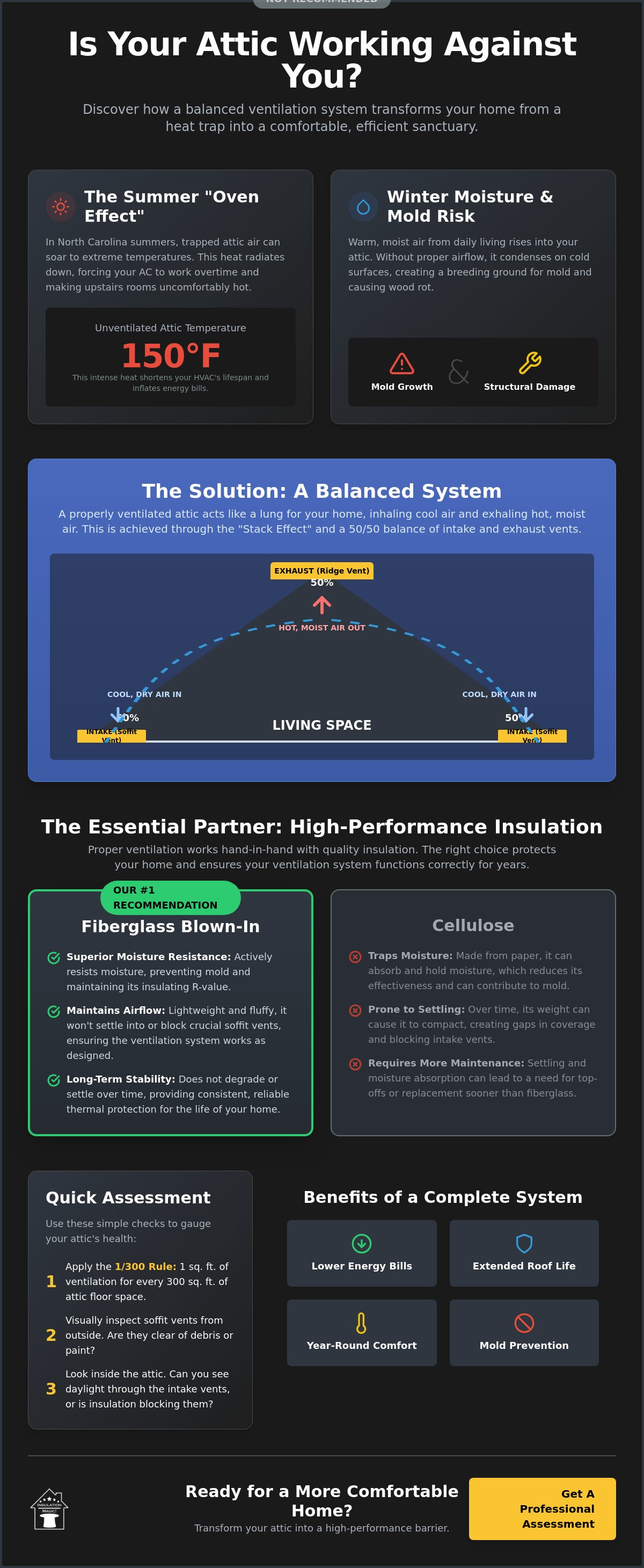
In cities like Charlotte and Waxhaw, the summer sun beats down on asphalt shingles, turning your attic into what experts call the "Oven Effect." This trapped heat doesn't stay confined; it radiates downward through your ceiling and into your living spaces, making your upstairs rooms feel significantly warmer than the rest of the house. Balanced ventilation is the equal exchange of air to maintain attic temperatures near ambient outdoor levels.
Combating the North Carolina Summer Heat
On a typical July afternoon, an unventilated attic can soar to a staggering 150°F. This intense heat forces your air conditioner to run longer and harder, which significantly shortens the lifespan of your expensive HVAC system. To truly protect your home, you need a system where airflow works in harmony with high-quality fiberglass blown-in insulation. We always recommend fiberglass over cellulose because fiberglass doesn't settle as easily and allows for better moisture management. Learning how to lower heating and cooling costs starts with ensuring your attic isn't fighting against your AC.
Winter Moisture and the Risk of Mold
While we often focus on the summer heat, North Carolina's high humidity makes winter ventilation just as vital. Warm, moist air from your showers and cooking naturally migrates toward the roof. If it hits cold rafters without proper airflow, it turns into condensation. This dampness is a prime breeding ground for mold and can lead to wood rot in your roof's structure over time. Understanding The Anatomy of a Balanced Attic Ventilation System helps you see how constant airflow keeps your roof deck dry. By keeping air moving, you ensure that moisture never has a chance to settle, protecting your home's structural integrity through every season.
The Anatomy of a Balanced Attic Ventilation System
Think of your attic as a set of lungs. For it to function properly, it needs to inhale fresh air and exhale heat and moisture. This process relies on a physical principle called the "Stack Effect." Because hot air is naturally buoyant, it rises to the highest point of your roof. As this hot air escapes through exhaust vents, it creates a slight vacuum that pulls cooler, drier air into the attic through intake vents at the eaves. A successful attic ventilation improvement ensures this cycle happens continuously without mechanical help.
Achieving this requires following the Golden Rule of attic airflow: you must have an equal balance of intake and exhaust. If you have plenty of exhaust but no intake, the system stalls. If you have too much intake, the air may not circulate enough to reach the peak. It's also vital to avoid mixing different types of exhaust vents. For instance, combining a ridge vent with a gable vent can cause the air to "short-circuit." The ridge vent will pull air from the nearby gable vent instead of pulling it from the soffits. This leaves the lower parts of your attic hot and stagnant. You can find more technical details on these requirements in this guide on Practical Steps for Assessing and Upgrading Your Attic Airflow.
Intake Vents: The Foundation of Airflow
For most North Carolina homes, soffit vents installed under the eaves are the most effective intake solution. However, these vents only work if they aren't blocked by your insulation. This is where meticulous craftsmanship matters. We use baffles, or rafter vents, to create a clear channel for air to flow over the insulation and into the attic space. We prefer using high-quality fiberglass blown-in insulation for this reason. Unlike cellulose, which is heavier and prone to shifting or settling into these air gaps, fiberglass stays exactly where it's placed. This ensures your ventilation remains clear for years to come.
Exhaust Vents: Letting the Attic Breathe
Exhaust vents sit at or near the roof's peak to let the hottest air out. Ridge vents are a popular choice because they provide a continuous opening along the entire roofline, offering a sleek look and high efficiency. Gable vents, located on the vertical side walls of the house, are traditional but can sometimes leave "dead zones" in larger or more complex attics. In some cases, we may recommend Attic Fans to provide an extra boost in homes with stubborn heat pockets. If you aren't sure which setup is right for your roof, you can schedule an attic assessment to get a clear picture of your home's needs.
Practical Steps for Assessing and Upgrading Your Attic Airflow
Determining if your home needs an attic ventilation improvement doesn't always require a ladder and a toolkit. You can begin with a few simple calculations and observations to see if your system is functioning as a balanced unit. The standard guideline used by professionals is the 1/300 rule. This means you should have at least 1 square foot of ventilation for every 300 square feet of attic floor space. For a 1,500 square foot attic, you need at least 5 square feet of net free area, split equally between intake and exhaust.
Once you have the math down, look for physical evidence of poor airflow. Check your rafters for rusty nails or dark water stains. These are clear indicators that moisture is being trapped rather than exhaled. You should also evaluate your current insulation levels. In many North Carolina homes, older cellulose insulation has settled or been blown into the eaves, completely choking off the intake vents. We prefer high-quality fiberglass blown-in insulation because it is easier to keep clear of your soffits and provides superior thermal protection without the weight and moisture-trapping issues of cellulose. If you find these red flags, it may be time to explore professional attic services to restore your home's health.
The DIY Flashlight Test
A simple way to check your intake is the daylight test. On a bright afternoon, turn off all the lights in your attic and look toward the eaves. You should see a consistent glow or "halo" of light coming through the soffit vents. If it's pitch black, your vents are likely clogged with debris, painted over, or buried under old insulation. While you're up there, check for "hot spots." If you notice shingles curling or felt paper becoming brittle in specific areas, it's a sign that heat is pooling in those pockets and baking your roof from the inside out.
When to Call a Professional Contractor
While DIY checks are helpful, a full attic ventilation improvement often requires technical tools. Professionals use smoke pens to track the actual path of air or thermal cameras to identify exactly where heat is bypassing your insulation. Cutting into a roof deck to add ridge vents or installing power fans requires structural knowledge to avoid compromising your home's integrity. You can see how we've helped other homeowners solve these complex airflow puzzles by reading our customer reviews. If your upstairs is still too hot, book your professional attic assessment today to get a customized plan for your home.
Beyond Vents: How Insulation and Air Sealing Complete the System
Installing new vents is a vital step, but even the best attic ventilation improvement will underperform if the attic floor isn't properly prepared. Think of your home like a thermos; the vents allow the outer shell to breathe, but the air sealing and insulation keep the contents at the right temperature. Without a meticulous air seal, your vents can actually create a vacuum effect that pulls expensive, conditioned air from your living rooms straight into the attic. This is why we always address the "floor" of your attic before finalizing the "roof" ventilation.
Another factor homeowners often overlook is the "Wind Wash" effect. This occurs when the very air meant to cool your attic moves across the top of your insulation and strips away its thermal effectiveness. If you have low-quality or improperly installed materials, this moving air can significantly degrade your R-value. Our approach focuses on creating a robust thermal envelope where airflow and insulation work in harmony rather than against each other. Meticulous craftsmanship in these details ensures that your attic ventilation improvement delivers the savings you expect.
The Superiority of Fiberglass Blown-In Insulation
When it comes to high-airflow environments, we exclusively recommend fiberglass blown-in insulation over cellulose. Fiberglass is naturally moisture-resistant, which is critical in the humid North Carolina climate. While cellulose is made of recycled paper that can trap humidity and eventually sag or clump, fiberglass maintains its loft and R-value even when exposed to constant attic airflow. For families in Matthews and Mint Hill, this means a cleaner, safer, and more durable solution that won't lose its effectiveness over time. It's a choice that reflects our commitment to long-term protection and peace of mind.
Air Sealing: The Essential Partner to Ventilation
Air sealing is the invisible hero of a comfortable home. Before we add more vents, we carefully seal "top plates," wire penetrations, and plumbing stacks where air leaks most often. This step ensures that your AC stays where it belongs: inside your home. Proper air sealing prevents your ventilation system from accidentally exhausting the air you've already paid to cool. For a deeper look at how these elements work together, explore our energy efficient home insulation guide. By combining precision sealing with high-quality fiberglass, we create a system that truly protects your comfort and your wallet.
Take Control of Your Home's Comfort Today
A balanced attic ventilation improvement is more than just a simple home repair; it's a long-term investment in your property's health and your family's daily comfort. By ensuring a steady exchange of air and pairing it with expert air sealing, you prevent heat from becoming trapped and driving up your monthly utility costs. We prioritize meticulous air sealing in every project to ensure your home's thermal envelope remains intact and efficient.
Our team specializes in high-quality fiberglass blown-in insulation because it offers the durability and moisture resistance that North Carolina homes require. Unlike cellulose, fiberglass maintains its loft and allows your attic to breathe freely without the risk of settling or clumping over time. We take immense pride in serving homeowners in Charlotte, Matthews, and Weddington with methodical, local care. You don't have to live with an overheated second floor or the fear of hidden roof damage any longer.
Schedule your professional attic ventilation assessment with Insulation Magic! today.
We look forward to helping you restore your home's comfort and creating a more efficient environment for your family to enjoy.
Frequently Asked Questions
Will improving attic ventilation make my house colder in the winter?
No, a properly ventilated attic won't make your living spaces colder because the airflow only affects the area above your home's thermal envelope. As long as your attic floor is meticulously air-sealed and protected by high-quality fiberglass blown-in insulation, the heat stays inside your rooms where it belongs. Ventilation actually helps in winter by removing trapped moisture that could otherwise lead to condensation and mold growth on your rafters.
How many soffit vents do I need for a 1,500 square foot attic?
For a 1,500 square foot attic, you generally need a total of 5 to 10 square feet of net free ventilation area. The 2018 North Carolina State Building Code requires a minimum of 1 square foot of ventilation for every 150 square feet of attic space, though the 1/300 rule is common for balanced systems. This total area must be split equally between intake vents at the eaves and exhaust vents at the roof peak to ensure a steady flow of air.
Is a powered attic fan better than a ridge vent for Charlotte homes?
A ridge vent is typically the preferred choice because it provides continuous, passive airflow along the entire roofline without using any electricity. While Charlotte summers are intense, a ridge vent is highly reliable and doesn't require the maintenance that mechanical parts do. We often suggest a professional attic ventilation improvement that prioritizes these passive systems first, though we may recommend attic fans for specific homes with stubborn heat pockets that passive airflow cannot reach.
Can I just install more vents myself or do I need a pro?
While clearing debris from your existing vents is a great DIY task, installing new vents usually requires a professional's touch to protect your roof's structural integrity. Cutting into the roof deck or eaves involves complex weatherproofing that is vital for preventing leaks. A professional ensures your vents are placed to avoid "short-circuiting" the airflow and confirms that your fiberglass insulation isn't blocking the new intake paths. This methodical approach guarantees your home stays protected and efficient.
What are the signs that my current attic ventilation is failing?
Common signs of failure include second-story rooms that stay uncomfortably hot, curling or brittle roof shingles, and dark water stains or rusty nails on your attic rafters. If your utility bills are climbing during the summer, it's often because your attic is acting like an oven and radiating heat downward. A professional attic ventilation improvement can address these issues by restoring the natural balance of air, which lowers the stress on your HVAC system and restores your home's comfort.
Does attic ventilation help extend the life of my roof shingles?
Yes, proper ventilation is critical for maximizing the lifespan of your roof shingles by preventing them from "baking" in the summer sun. Without airflow, attic temperatures can soar to 150°F, causing shingles to become brittle and lose their protective granules prematurely. By keeping the roof deck closer to the ambient outdoor temperature, you protect the asphalt from thermal damage. This simple balance can save you from the high cost of a premature roof replacement.
Disclaimer
This blog is intended to provide general information about insulation, energy efficiency, and home comfort based on years of experience. While we strive to keep content accurate and up to date, results may vary based on your home's construction, condition, and climate. Contact Insulation Magic for a personalized assessment and recommendations.


