
What if that one sweltering bedroom isn't actually a sign that your expensive HVAC system is failing? Many homeowners across the Charlotte area struggle with uneven temperatures in house layouts, often assuming a costly mechanical replacement is the only solution. It's incredibly frustrating to pay rising utility bills every month only to toss and turn in a room that feels ten degrees hotter than the rest of the house. You've likely tried adjusting vents or buying heavy curtains, yet the discomfort remains and the anxiety about your home's efficiency continues to grow.
You deserve to feel total peace of mind and consistent comfort in every room you own. We'll help you look beyond the thermostat to find the hidden causes of these thermal gaps and validate why your AC might not be the culprit. In this article, we'll explain how a meticulous approach to air sealing and fiberglass blown-in insulation can solve these issues for good. You'll learn why fiberglass is the superior choice for your attic and how professional craftsmanship can lower your monthly bills while finally making every bedroom a sanctuary for sleep.
Key Takeaways
- Understand that uneven temperatures in house layouts are often caused by a failing thermal envelope rather than an expensive HVAC issue.
- Learn how the "Stack Effect" pulls conditioned air out of your rooms and why the attic is the primary culprit for second-floor discomfort.
- Discover why air sealing is the essential "windbreaker" that protects your home from energy leaks, making your insulation truly effective.
- See why fiberglass blown-in insulation is the superior, long-term choice for attic performance when compared to cellulose or spray foam options.
- Find out how a professional attic assessment and the meticulous removal of old materials can lower your monthly utility bills while restoring total comfort.
Why Your House Has Hot and Cold Spots: The Science of Uneven Temperatures
Your air conditioning unit might be in perfect mechanical health, yet you still find yourself avoiding certain rooms during a Charlotte afternoon. This happens because uneven temperatures in house environments are rarely just about the machinery. Instead, they are often a result of a compromised thermal envelope. Think of your home as a high end cooler. If the lid is cracked open, it doesn't matter how much ice you put inside; the drinks will eventually get warm. In your home, the attic is that lid.
To truly grasp the science of uneven temperatures, you have to recognize the difference between radiant heat and convective heat. Radiant heat is the sun beating down on your shingles, turning your attic into an oven that radiates heat through your ceiling. Convective heat is the actual movement of air through leaks and gaps. When your home has these invisible openings, these two forces work together to bypass your thermostat's best efforts. Your HVAC might be blowing cold air, but if that air is being pulled out of the room as fast as it enters, you'll never feel comfortable.
The Stack Effect: Why Your AC is Fighting Gravity
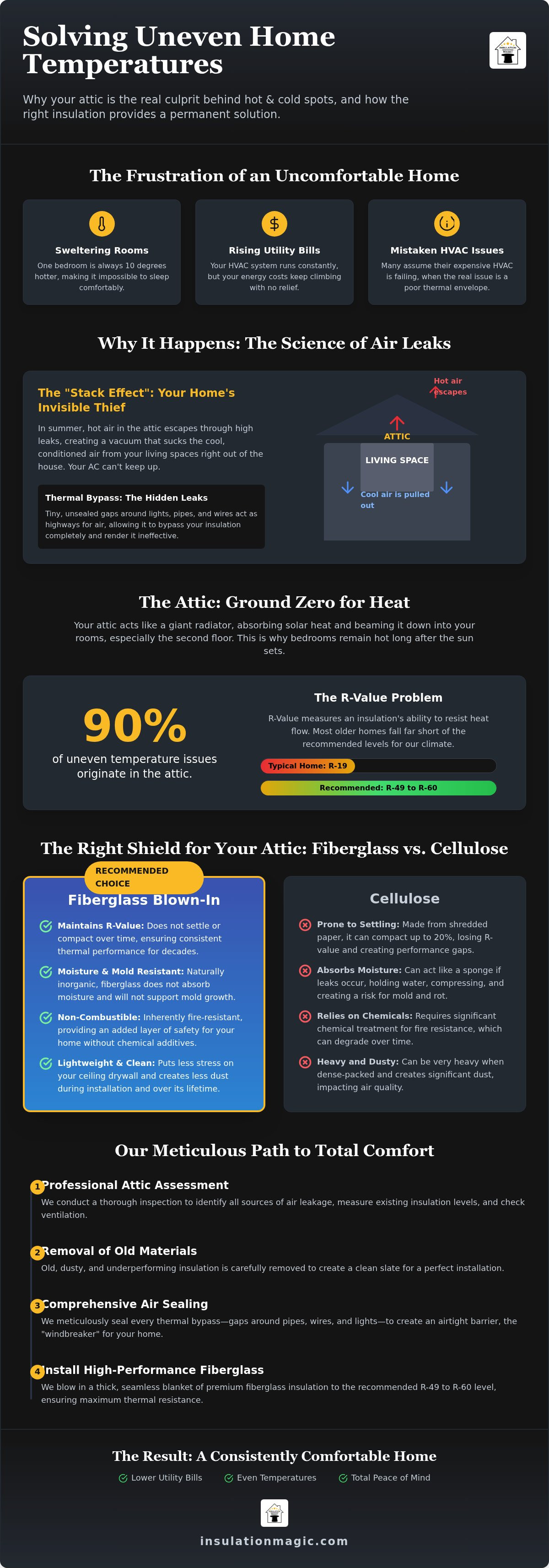
Heat naturally moves from areas of high pressure to low pressure. In the summer, the scorching air in your attic creates immense pressure that tries to push its way into your living space. As this warm air rises and escapes through tiny gaps in your roofline, it creates a vacuum effect. This vacuum sucks the heavy, conditioned air right out of your rooms. This phenomenon, known as the Stack Effect, is why the second floor is always the hardest to cool during a humid North Carolina summer. It's an exhausting cycle where your AC is essentially fighting gravity; and without proper sealing, it's a fight the machine cannot win.
Thermal Bypass: The Invisible Leaks You Can’t See
Many homeowners believe insulation is a solid barrier, but air can actually move right through it if the area isn't properly sealed. A thermal bypass is a hidden pathway that allows air to skip over your insulation entirely. These leaks occur around recessed lights, plumbing stacks, wire penetrations, and wall partitions. We often describe the attic as the "lung" of the house. If that lung has holes, the entire system struggles to regulate itself. This constant movement of air through walls and floors is the primary reason uneven temperatures in house settings persist even after you've serviced your HVAC unit. Identifying these bypasses requires a meticulous eye, as they are often buried under old, dusty insulation.
The Attic Connection: Why Your Second Floor is Sweltering
If you feel like your upstairs is a different climate zone than your downstairs, you aren't alone. In our experience, roughly 90% of uneven temperatures in house layouts originate in the attic. While some might suggest closing vents to redirect air, this often strains your HVAC system without solving the actual problem. The real issue is that your attic acts like a giant radiator sitting right above your bed. During a Charlotte summer, the sun can heat your roof shingles to over 150 degrees, and that heat has nowhere to go but down. Without a proper barrier, your second-story ceilings absorb this energy and radiate it directly into your bedrooms.
Inadequate R-Values in North Carolina Homes
R-value is a measure of insulation's thermal resistance, and for North Carolina's Zone 4 climate, reaching a level of R-49 to R-60 is the gold standard for stopping heat transfer. Unfortunately, many older homes in neighborhoods like Matthews or Waxhaw were built with much lower standards. Over time, original insulation also suffers from "settling," where it loses its loft and its ability to trap air. When your insulation is thin or degraded, it can't stop that radiant heat from migrating through your drywall. We consistently find that replacing old, settled material with fresh fiberglass blown-in insulation is the most effective way to restore that thermal barrier and keep your ceilings cool to the touch.
Attic Ventilation and Heat Retention
Stagnant, superheated air in your attic is a primary driver of nighttime discomfort. If that heat is trapped, your ceiling becomes a heater that stays warm long after the sun goes down. This is why many homeowners find their bedrooms sweltering at 10:00 PM even with the AC running full blast. Using a DIY Home Energy Audit can help you spot where heat is penetrating, but often the solution involves improving airflow. Installing attic fans can help move that trapped air, significantly reducing the thermal load on your second floor and allowing your HVAC to actually keep up with the thermostat settings.
Combining better ventilation with a fresh layer of fiberglass blown-in insulation creates a much more stable environment. This approach is a key part of how to lower heating and cooling costs permanently. It's about protecting your home's envelope so your equipment doesn't have to work overtime. If you are tired of the heat, you might consider having a professional look at your current setup through an online booking for a thorough assessment.
Air Sealing: The Secret to Stopping Energy Loss and Drafts
Imagine standing outside on a windy Charlotte day wearing a thick wool sweater but no jacket. The sweater is great at holding heat, but the wind cuts right through the fibers, stealing your warmth. In your home, insulation is that sweater, and air sealing is the windbreaker. Most homeowners only focus on the sweater, which is why they still struggle with uneven temperatures in house environments even after adding more insulation. Air sealing is the most overlooked step in home comfort, yet it's the foundation of a high performing attic. It prevents the air you've already paid to cool from escaping into the attic space where it does you no good.
Meticulous Identification of Leak Points
When we enter an attic, we don't just look at the surface. We look for the hidden gaps where your walls meet the attic floor, known as top plates. These are essentially open chimneys that allow air to bypass your insulation entirely. We also look for "dirty" insulation. Fiberglass acts like a filter; if it looks dark or dusty in specific spots, that’s a clear sign that air is filtering through it from your living space below. We take the time to educate you on these points, showing you exactly where plumbing stacks and recessed lights are leaking your expensive AC. It's a methodical process that ensures every square inch of your thermal envelope is protected from unwanted air movement.
Why Insulation Alone Fails Without a Seal
If you simply blow new fiberglass over these leaks, you haven't solved the problem. Air moves right through fiberglass; it doesn't stop it. By meticulously sealing these gaps first, we ensure the conditioned air stays in your bedrooms where it belongs. This is the invisible secret to a comfortable home. Once the windbreaker is in place, your fiberglass blown-in insulation can finally do its job of resisting heat transfer. This two step process is the only way to permanently fix uneven temperatures in house layouts and ensure long term savings. Without this seal, even the best insulation will underperform, leaving you with the same hot spots you had before.
Taking this extra step is what separates a standard job from a professional restoration of comfort. If you want to dive deeper into how this works, you can read our Home Air Sealing Pillar for a complete guide on these invisible leaks and how they impact your monthly utility bills.
Fiberglass Blown-In vs. Cellulose: Choosing the Right Shield
Selecting the right "sweater" for your attic is the final step in creating a balanced home. If you pick the wrong material, you'll likely find that uneven temperatures in house zones return as the insulation settles or degrades. At Insulation Magic!, we've spent years assessing different materials in the Charlotte climate. Our conclusion is clear: fiberglass blown-in is the gold standard. It offers the most consistent thermal protection without the messy side effects of older alternatives. We prioritize your long-term comfort over quick fixes, which is why we're so selective about what we install.
Why Fiberglass Wins in the North Carolina Climate
Modern fiberglass blown-in is a marvel of efficiency. It's incredibly lightweight, so it won't put undue stress on your drywall ceilings. More importantly, it's highly resistant to the moisture and mold that often plague North Carolina attics during the humid months. Since it's made of inorganic glass fibers, it doesn't provide a food source for pests or fungi. This meticulous choice of material means your R-value stays exactly where it needs to be for decades. You won't have to worry about your insulation shrinking away from the edges of your attic floor, which is a common cause of recurring hot spots.
The Problem with Cellulose and Spray Foam
While cellulose is often marketed as "green," it's essentially ground-up paper that can become a dusty mess. It's prone to settling, which leaves gaps in your thermal shield and invites uneven temperatures in house layouts back into your life. While cellulose is significantly heavier than fiberglass and tends to pack down over time, fiberglass maintains its loft and thermal resistance for decades. We also avoid spray foam because it's an aggressive, permanent modification. Foam can mask roof leaks and makes future accessibility for repairs or upgrades a nightmare. We believe in protecting your home's integrity, not just filling it with chemicals.
Restoring Comfort in Charlotte: The Insulation Magic! Approach
Solving uneven temperatures in house layouts requires more than just a quick spray or a few extra batts. It requires a disciplined, step-by-step restoration of your home's thermal boundary. For families in neighborhoods like Ballantyne or Weddington, our approach is built on transparency and long-term value. We treat your property with the same care we'd give our own, ensuring that the "how" and "why" of our work are always clear to you. This methodical process is designed to lower your stress by providing a permanent solution to seasonal discomfort.
Professional Assessment and Old Insulation Removal
Many companies suggest simply blowing new material over what's already there. We believe this is a mistake that compromises the quality of the project. Old insulation is often compressed, dusty, or even damaged by pests over the years. By performing a professional insulation removal in Charlotte, we create a clean slate. This allows us to see the actual structure of your attic floor, identifying every hidden air leak that was previously buried under feet of debris. Removing old material also eliminates allergens and rodent waste, which significantly improves the air quality inside your living spaces.
Once the attic is empty and cleaned, we begin the meticulous work of air sealing. We seal every wire penetration, plumbing stack, and top plate using high-quality materials. Only after we've verified that the "windbreaker" is airtight do we blow in the fresh fiberglass. This isn't a rushed job; it's a methodical project designed to last for the life of your home. Homeowners in Waxhaw and Matthews can expect a quiet, clean installation where the only evidence of our visit is a cooler, more comfortable bedroom.
The Path to Permanent Comfort
Our goal is to provide you with a home that finally stays at the temperature you set on the thermostat. We don't just guess that the leaks are gone; we verify our work at every checkpoint throughout the day. This "Meticulous Craftsman" philosophy ensures that your uneven temperatures in house zones are resolved once and for all. You'll notice the difference on your next utility bill and in the quality of your sleep. If you're ready to stop fighting your HVAC system and start enjoying your home again, you can book your online assessment now to begin the process.
Take Control of Your Home’s Climate and Comfort
Living with uneven temperatures in house zones doesn't have to be your permanent reality. You now understand that the secret to a balanced home lies in a meticulous approach to air sealing and the superior performance of fiberglass blown-in insulation. By addressing the invisible gaps in your attic and avoiding the pitfalls of settling cellulose or risky spray foam, you can finally enjoy a consistent temperature in every bedroom.
As your local Charlotte experts, we take immense pride in our craftsmanship and our commitment to transparency. Our 5-star reviews reflect a dedication to solving complex comfort issues through precise assessments and careful execution. We focus on protecting your home environment with clean, long-lasting materials that provide immediate relief and lower monthly energy bills.
You deserve a home that feels exactly how you want it to, every single day. We look forward to helping you reclaim your peace of mind and total comfort.
Frequently Asked Questions
Why is my second floor so much hotter than my first floor?
Your second floor is hotter because of the "Stack Effect" and radiant heat from your roof. Hot air in the attic can reach 150 degrees, turning your ceiling into a giant radiator. Without a meticulous air seal and proper fiberglass barrier, this heat migrates directly into your bedrooms. This pressure also forces your expensive air conditioning to work harder, often failing to keep up with the rising temperatures upstairs while the downstairs stays chilly.
Will adding more insulation fix the hot spots in my house?
Adding more insulation alone often fails to solve the problem if air leaks are still present. If your home has uneven temperatures in house zones, it's likely because air is bypassing your current insulation through gaps around lights and pipes. Simply blowing new material over these holes is like putting a sweater on over a wound. You must perform air sealing first to create a true thermal boundary that actually holds your conditioned air.
How do I know if I need air sealing or just more insulation?
You likely need both, but you can check for air leaks by looking for dark or "dirty" spots in your current insulation. These areas act like filters, catching dust as air escapes from your living space into the attic. If your insulation looks dusty or thin near wall partitions and plumbing stacks, air sealing is essential. A professional assessment will identify these hidden bypasses that a simple visual check might miss.
Can uneven temperatures be caused by my crawlspace?
Absolutely. Your home acts like a chimney, pulling air from the lowest point to the highest. If your crawlspace is damp or uninsulated, that air is sucked up through floor penetrations and wall cavities. This contributes to uneven temperatures in house designs by making floors feel cold in winter and humid in summer. Encapsulating or properly insulating your crawlspace is a vital step in total home climate control and comfort.
Is fiberglass blown-in insulation better than cellulose?
We exclusively recommend fiberglass blown-in because it maintains its R-value without the significant settling issues seen with cellulose. Fiberglass is naturally moisture-resistant and won't rot or support mold growth in our humid North Carolina climate. It's also a cleaner, non-corrosive material that doesn't create the fine paper dust associated with cellulose. For long-term protection and peace of mind, fiberglass is the superior choice for your attic and your family's health.
How long does it take to fix uneven temperatures in a home?
Most attic restoration projects are completed in just one to two days. This methodical process includes the removal of old, ineffective materials, followed by meticulous air sealing of all bypasses. Finally, we blow in the fresh fiberglass to the recommended depth. While the timeline is short, the results are immediate. You'll notice a more consistent temperature throughout your home and a quieter, cleaner environment the very first night after our team finishes.
Does attic fan installation really help with cooling?
Attic fans are highly effective at moving stagnant, superheated air out of your attic space. By reducing the ambient temperature of the attic, you lower the thermal pressure on your second-story ceilings. This allows your insulation to work more efficiently and helps your HVAC system maintain a comfortable temperature without running constantly. In towns like Matthews and Waxhaw, these fans are a key component of a high-performing strategy to restore home comfort.
What is the recommended R-value for homes in Charlotte, NC?
In the Charlotte metro area, which falls under Climate Zone 4, the current recommendation is to reach an R-value of R-49 to R-60. Achieving this level typically requires about 18 inches of fiberglass blown-in insulation. While the North Carolina building code requires a minimum of R-38, reaching the higher recommended range provides the best return on investment. It ensures your home remains protected against both sweltering summer heat and occasional winter freezes.
Disclaimer
This blog is intended to provide general information about insulation, energy efficiency, and home comfort based on years of experience. While we strive to keep content accurate and up to date, results may vary based on your home's construction, condition, and climate. Contact Insulation Magic for a personalized assessment and recommendations.


