
Did you know that a home built before 2000 in Charlotte likely has an attic insulation level of R-19 or less, which is less than half of what modern standards require? If you’ve noticed your second floor feels like a sauna during a humid July afternoon or your utility bills seem to climb every month, you aren't alone. It's frustrating to feel like your air conditioner is fighting a losing battle against the heat trapped just above your ceiling.
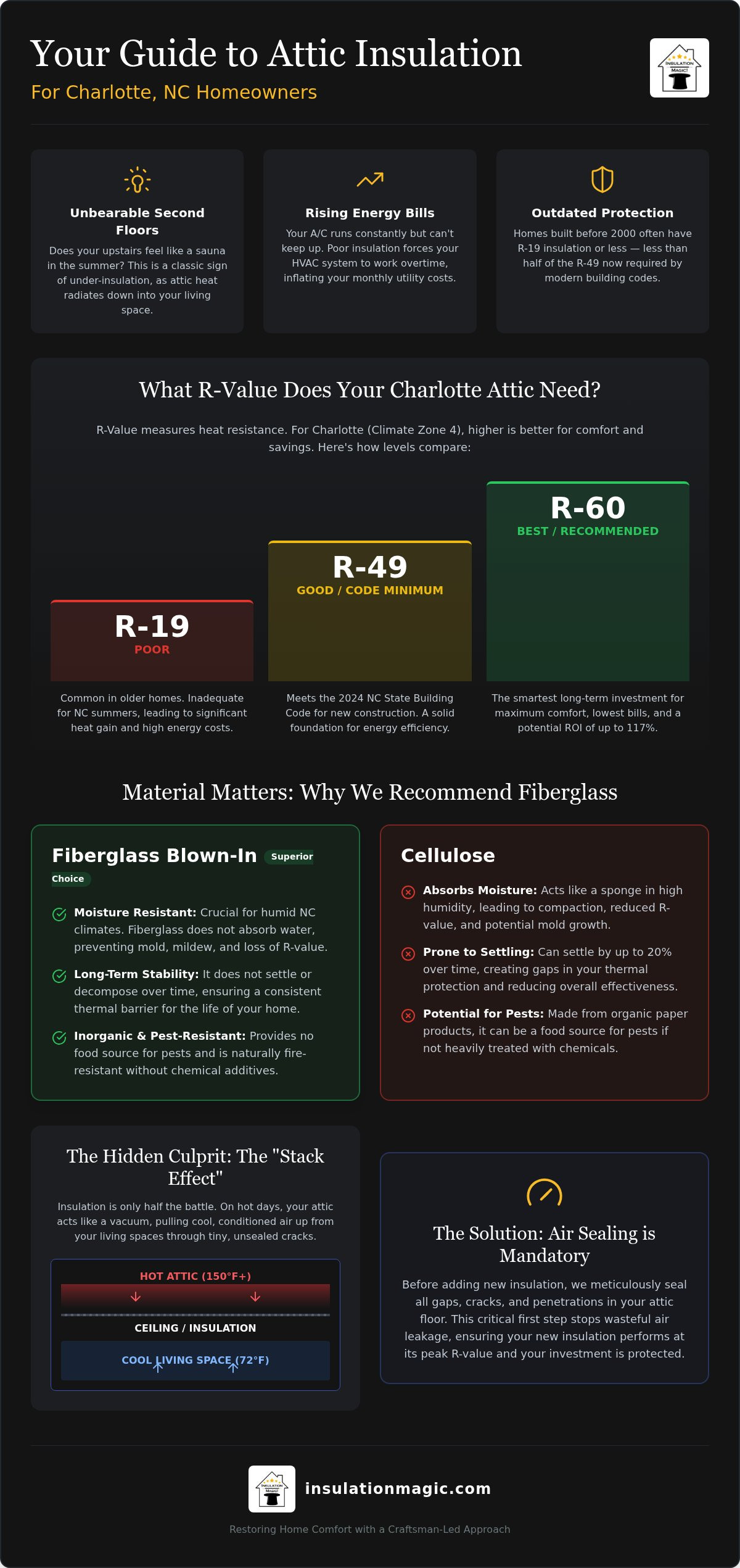
In this guide, we'll clarify exactly what R-value for attic in NC your home needs to restore comfort and slash those cooling costs. According to the 2024 North Carolina State Building Code, homeowners in Charlotte's Climate Zone 4 should aim for a minimum of R-49. However, for the best performance and a potential return on investment of up to 117%, we recommend targeting a range between R-49 and R-60 using high-quality fiberglass blown-in insulation. You'll learn why we prioritize fiberglass for its longevity and moisture resistance, how air sealing acts as the secret weapon for efficiency, and how to navigate current 2026 state rebate programs to make your project more affordable.
Key Takeaways
- Learn exactly what R-value for attic in NC your home requires to meet current building codes and maximize energy efficiency.
- Discover how proper insulation levels combat the "Stack Effect" to keep your second floor comfortable even on the hottest Charlotte afternoons.
- Understand why fiberglass blown-in insulation provides superior moisture resistance and longevity for North Carolina homes compared to cellulose.
- Identify why air sealing is a critical step that prevents your new insulation from losing its effectiveness through hidden attic drafts.
- Gain the knowledge needed to hire a professional who uses a meticulous, craftsman-led approach to restore your home's year-round comfort.
Understanding R-Value Requirements for North Carolina Homes
Before we look at the specific numbers, it is helpful to understand the basic science of how your home stays comfortable. In the insulation industry, we use a term called R-value to measure how well a material resists heat flow. If you are interested in the technical physics behind it, Understanding R-Value involves looking at how thermal resistance prevents heat from moving from your hot attic into your cooled living spaces. The higher the R-value, the better the material is at keeping that heat where it belongs.
North Carolina homeowners often face a unique challenge compared to our neighbors further south. While Florida homes deal with constant heat, we experience significant temperature swings and high humidity. This means we need a more robust thermal barrier to keep our homes efficient year-round. When you ask what R-value for attic in NC is best, you have to look at both the legal minimums and the actual efficiency targets that will save you money.
Climate Zones in NC: Why Your Location Matters
North Carolina is divided into different climate zones, which dictates how much insulation you need. While many people assume Charlotte is in a warmer zone, the 2024 North Carolina State Building Code actually places Charlotte in Climate Zone 4. This classification is due to our specific mix of hot, humid summers and moderately cold winters. If you live in Waxhaw or Matthews, you are following the same Zone 4 standards as the rest of the metro area.
Mountain regions further west might deal with even colder temperatures, but for our local area, the requirements are clear. The current code mandates a minimum of R-49 for new builds. However, for existing homes, simply meeting the code isn't always enough to stop those high summer utility bills. We often see older homes with only R-19, which is why we focus on bringing those levels up to modern standards using high-performance fiberglass blown-in insulation.
The ENERGY STAR Recommendation for NC Attics
For most existing homes in North Carolina, the baseline recommendation usually falls between R-38 and R-49. This provides a solid foundation for comfort, but it is often just the starting point for a truly efficient home. In 2026, the most effective definition of R-value for NC attics is a thermal resistance rating of R-49 to R-60 that provides a continuous, moisture-resistant barrier against the heat.
While R-49 is the code requirement for new construction, aiming for R-60 is often the smartest long-term investment for homeowners. This higher level of protection ensures that even during record-breaking heatwaves, your HVAC system won't have to work overtime. At Insulation Magic!, we prioritize using fiberglass blown-in for these upgrades because it maintains its R-value over time and handles our local humidity much better than cellulose ever could. You can learn more about how we apply these standards on our services page.
Why Your Attic R-Value is the Key to Comfort in Charlotte
Living in Charlotte means dealing with a specific kind of atmospheric pressure inside your home. Many two-story homeowners notice that even when the AC is set to 70 degrees, the upstairs bedrooms feel like a different climate zone. This is often caused by the "Stack Effect." Hot air in your attic creates a pressure imbalance that pulls conditioned air out of your living spaces and into the attic through small gaps. When you research what R-value for attic in NC is necessary, you're really looking for the solution to this constant tug-of-war between your HVAC and the outdoors.
Your air conditioner isn't just fighting the humidity; it's fighting the heat radiating from your ceiling. Without sufficient insulation, your ceiling acts like a giant radiator. High R-values create a thermal break that protects your HVAC system from overworking. This extends the life of your equipment and prevents those emergency repair calls in the middle of a July heatwave. Many local experts agree that upgrading your attic provides the biggest bang for your buck when it comes to home improvements. It is a methodical way to restore peace of mind and lower your monthly expenses.
Battling the Humidity and Heat of NC Summers
Charlotte summers are relentless. On a 95-degree day, your attic temperature can easily soar to 150 degrees. This heat doesn't just sit there. It moves through your ceiling via conduction. We recommend fiberglass blown-in insulation because it creates a dense, consistent blanket that blocks this heat flow more effectively over time than cellulose. Learning how to lower heating and cooling costs starts with understanding that your attic is the front line of this battle. Fiberglass is particularly well-suited for our climate because it doesn't lose its effectiveness when the humidity rises.
Keeping the Heat In During Damp NC Winters
While we focus on the heat, North Carolina winters bring their own set of challenges. Our winters are often damp and chilly. Proper R-value keeps the expensive heat you pay for from escaping through your roof. It also plays a vital role in moisture control. In our humid climate, fiberglass is superior because it doesn't settle or trap moisture like organic materials might. This protects your roof deck and prevents the rare but damaging ice dams that can occur during our occasional winter storms. If you're tired of a hot second floor, you can schedule a professional attic assessment to see where your current insulation is falling short.
Choosing the Right Material: Why Fiberglass Blown-In Wins
Selecting a target number for your home's efficiency is a great start, but that number is only as good as the material providing it. When you are looking at what R-value for attic in NC your home needs, you have to consider how that material will behave five, ten, or twenty years from now. At Insulation Magic!, we've built our reputation on a meticulous methodology that prioritizes your home's long-term health. That is why we exclusively recommend fiberglass blown-in insulation for attic applications. It provides the most reliable thermal barrier for the specific climate challenges we face in Charlotte.
The Performance of Fiberglass Blown-In
Fiberglass is essentially spun glass. This makes it naturally non-combustible without the need for heavy chemical additives, providing an extra layer of safety for your family. Unlike other loose-fill options, fiberglass is remarkably stable. It resists settling; the R-49 or R-60 level we install today will remain at that height for decades. It also wins on the "clean factor" for homeowners. Because it is inorganic, it doesn't provide a food source for pests or mold. This contributes to much better indoor air quality for your household compared to organic alternatives.
Why We Avoid Cellulose in North Carolina
Determining what R-value for attic in NC is best for your property involves more than just thickness. Many big-box retailers push cellulose as an eco-friendly alternative, but it often fails to stand up to the unique demands of the Charlotte climate. Cellulose is made of recycled paper treated with fire retardants. In our humid environment, that paper acts like a sponge, absorbing moisture from the air. This added weight can actually stress your ceiling drywall, leading to visible sagging or cracks over time. Those fire-retardant chemicals can also degrade, leaving you with a pile of dusty paper in your attic that no longer provides the protection you expected.
Our craftsman-led approach also excludes spray foam. While some promote it as a quick fix, we believe in the reliability of the air sealing and fiberglass combination. This allows your home to breathe properly while maintaining a consistent thermal barrier. We take immense pride in this disciplined focus on quality. It ensures your attic refresh provides lasting value without the risks associated with more aggressive, chemical-heavy methods. By choosing the right material from the start, you protect both your investment and your family's comfort.
Beyond the Number: Why Air Sealing is Mandatory
You can install enough fiberglass to reach R-60, but those efforts might be wasted if your attic floor isn't properly sealed. Think of your attic floor like a piece of Swiss cheese. Small holes for electrical wires, plumbing stacks, and recessed light fixtures allow air to bypass your insulation entirely. When you ask what R-value for attic in NC is sufficient, you must include air sealing in that calculation. Without it, the "Stack Effect" continues to pull your expensive conditioned air right through the porous insulation and out of your house.
We often use a simple analogy to explain this relationship to homeowners. Insulation acts like a thick wool sweater. It is excellent at trapping heat to keep you warm. But if you stand in a cold wind with only a sweater on, the air blows right through the knit fibers. You need a windbreaker to stop the movement. Home air sealing is that windbreaker for your attic, ensuring your thermal barrier actually does its job.
The Secret to Stopping Energy Loss
Fiberglass blown-in is a phenomenal thermal barrier, but it is naturally designed to be breathable. While this is great for moisture management, it means the material cannot stop air movement on its own. Our meticulous process involves using professional-grade sealants to close the gaps in your top plates and around wire penetrations before we ever blow in a single bag of fiberglass. This step is vital because it prevents moisture-laden air from your living spaces from drifting into your attic. By stopping this air transfer, we protect your insulation and your roof deck from potential dampness and degradation.
How to Measure Your Existing Insulation R-Value
Before you can decide how much more material you need, you have to know your starting point. You can assess your current levels by following these four steps:
- Step 1: Measure the depth. Take a ruler into your attic and measure the thickness of your current insulation in several different spots to get an average.
- Step 2: Identify the material. Look at what you have. Is it pink or white fiberglass? Or is it grey, dusty cellulose?
- Step 3: Calculate your current R-value. Multiply your measured inches by the R-value per inch. For older fiberglass, you should use a value of approximately 2.5 per inch. If you have six inches, you are only at R-15.
- Step 4: Determine the gap. Compare your total to the modern target of R-49 or R-60 to see how much more fiberglass blown-in is required to restore your home's comfort.
Upgrading Your Attic with Insulation Magic! in Charlotte
Choosing the right team is just as important as choosing the right material. At Insulation Magic!, we've spent years serving homeowners across Charlotte, Waxhaw, and Matthews. We understand that your home is your sanctuary, not just a job site. This is why we approach every project with the mindset of a "Meticulous Craftsman." We don't just blow in insulation and leave. We educate you on why we're doing what we're doing, ensuring you feel confident in the long-term health of your attic.
In some cases, simply adding more fiberglass isn't the best path forward. If your current insulation is old, compressed, or has been visited by local pests, we might recommend professional insulation removal. This allows us to start with a clean slate, perform a perfect air seal on the attic floor, and then build back up to the proper R-value. Many homeowners worry about the cost to insulate, but we believe in transparent pricing and methodical work that pays for itself through lower utility bills and increased comfort.
Our Process: From Assessment to Protection
Our team follows a disciplined sequence to ensure nothing is missed. We start with a thorough attic inspection where we identify every hidden air leak and thermal bridge. Once the air sealing is complete, we move to the precision installation of blown-in fiberglass. We don't just guess at the depth; we use markers to ensure we hit the exact target to answer what R-value for attic in NC your specific home requires for modern standards. Finally, we perform a complete walkthrough. We take immense pride in our cleanliness and always leave your home in better condition than we found it.
Ready for a Cooler Home?
We know that inviting a contractor into your home requires trust. We encourage you to read our reviews to see how we've helped your neighbors restore comfort to their properties. Our goal is to provide a service that is as seamless as it is effective. If you're tired of dealing with a hot second floor and high cooling costs, we're ready to help. You can use our online booking tool to schedule your assessment and take the first step toward a more efficient, comfortable home.
Restore Year-Round Comfort to Your Charlotte Home
Achieving the right thermal balance in your home shouldn't be a guessing game. By targeting a range of R-49 to R-60 and prioritizing professional air sealing, you can finally stop the cycle of high utility bills and uncomfortable second floors. Our commitment to using high-quality fiberglass blown-in insulation ensures that your investment remains effective, stable, and moisture-resistant for decades to come. This methodical approach addresses the root causes of energy loss rather than just covering them up.
Understanding what R-value for attic in NC is required for modern efficiency is the first step toward a more sustainable and comfortable lifestyle. As an owner-operated local business with over 100+ 5-star reviews from homeowners across the metro area, we take immense pride in our meticulous craftsman approach. We specialize in fiberglass solutions because they offer the longevity and protection your family deserves. We're ready to help you transform your attic from an energy drain into a reliable shield for your property.
We look forward to partnering with you to restore the peace of mind and consistent temperatures your home has been missing. Your journey to a more efficient house starts with a simple, thorough inspection and a dedicated local expert by your side.
Frequently Asked Questions
Is R-38 enough for an attic in North Carolina?
While R-38 was a common target in previous years, it is no longer the ideal standard for Charlotte homeowners. Current 2024 building codes for our region require a minimum of R-49 to effectively combat the high humidity and summer heat. Sticking with R-38 often leads to a second floor that stays uncomfortably warm, forcing your air conditioner to run longer than necessary.
Can I just add more insulation on top of my old stuff?
You can certainly "top off" existing insulation if the material is dry and free of pests. However, simply adding more material without air sealing the attic floor first is a missed opportunity for efficiency. We recommend a meticulous approach where we identify and seal leak points before blowing in new fiberglass to ensure the heat doesn't just bypass your new thermal barrier.
How much does it cost to upgrade an attic to R-49 in Charlotte?
The total investment depends on the size of your attic and how many inches of material you currently have. Rather than focusing only on the initial outlay, it is helpful to consider that a proper attic upgrade can offer a return on investment of up to 117%. When determining what R-value for attic in NC is right for your budget, remember that higher levels pay for themselves through lower utility bills.
What is the best type of insulation for NC humidity?
Fiberglass blown-in is the superior material for the North Carolina climate. Because it is inorganic, it doesn't absorb moisture from our humid air like cellulose does. This prevents the insulation from becoming heavy, sagging, or losing its R-value over time. It provides a clean, stable, and long-lasting solution that protects your home’s air quality and structural integrity.
Does higher R-value help with noise reduction?
Yes, increasing the depth of your attic insulation provides a noticeable dampening effect against outside noise. When you move from a low level like R-19 up to R-49 or R-60, the thick layer of fiberglass acts as a sound absorber. This makes your home much quieter by reducing the sound of heavy rain on the roof and muffling neighborhood traffic or sirens.
How many inches of fiberglass equals R-49?
To reach a rating of R-49 with modern blown-in fiberglass, you generally need a depth of roughly 17 to 19 inches. This creates a deep, fluffy blanket that traps air effectively to resist heat transfer. When we perform an attic refresh, we use physical markers to ensure every corner of your space meets this specific depth for consistent, year-round protection.
Should I remove my old insulation before adding new R-value?
Removal is not always necessary, but it is the best choice if your current material is contaminated by rodents, mold, or moisture. Starting with a clean slate allows us to perform a perfect air seal on every wire penetration and top plate. This ensures that when you decide what R-value for attic in NC you want to reach, the new fiberglass performs at its maximum potential.
Can too much insulation cause mold in an NC attic?
Insulation itself does not cause mold, but improper installation can lead to moisture issues if attic vents are blocked. We use baffles to keep your soffit vents clear, allowing the attic to breathe as intended. By using fiberglass instead of cellulose, you also reduce the risk of mold because fiberglass does not trap moisture or provide a food source for organic growth.
Disclaimer
This blog is intended to provide general information about insulation, energy efficiency, and home comfort based on years of experience. While we strive to keep content accurate and up to date, results may vary based on your home's construction, condition, and climate. Contact Insulation Magic for a personalized assessment and recommendations.


