
Why does your upstairs bedroom feel like a sauna while your downstairs living room stays perfectly chilled? It's a frustrating reality for many local families, especially when those monthly utility bills arrive with a price tag that feels more like a second mortgage. You've likely suspected that your attic is the culprit, leaking expensive conditioned air while letting North Carolina's humidity seep into your living space. Learning how to improve attic energy efficiency Charlotte isn't just about dumping more material into your rafters; it's about a methodical approach to sealing, ventilating, and protecting your home.
You probably feel that your home's climate should be consistent and your bills should be predictable. We agree. This guide provides the step-by-step strategy to slash your utility bills and reclaim home comfort using Charlotte-specific efficiency secrets. We'll walk through the essential role of air sealing, explain why fiberglass blown-in insulation is the superior choice for our humid climate, and show you how to leverage the 30% federal tax credit to maximize your investment. By the end, you'll have a clear, craftsman-led plan to transform your attic into a high-performing thermal barrier.
Key Takeaways
- Learn the science behind the "Stack Effect" and how to improve attic energy efficiency Charlotte by addressing the unique thermal demands of Climate Zone 3A.
- Discover why air sealing is the indispensable "windbreaker" for your home that prevents expensive conditioned air from escaping through invisible gaps.
- Identify why fiberglass blown-in insulation provides superior moisture resistance and lasting performance compared to cellulose in our humid North Carolina climate.
- Master the balance of passive ventilation and active attic fans to effectively pull heat out of your home and maintain year-round comfort.
- Explore the 2026 financial incentives, including the 30% federal tax credit, that make upgrading your attic's efficiency more accessible than ever.
Understanding the Charlotte Heat: Why Attic Efficiency Fails
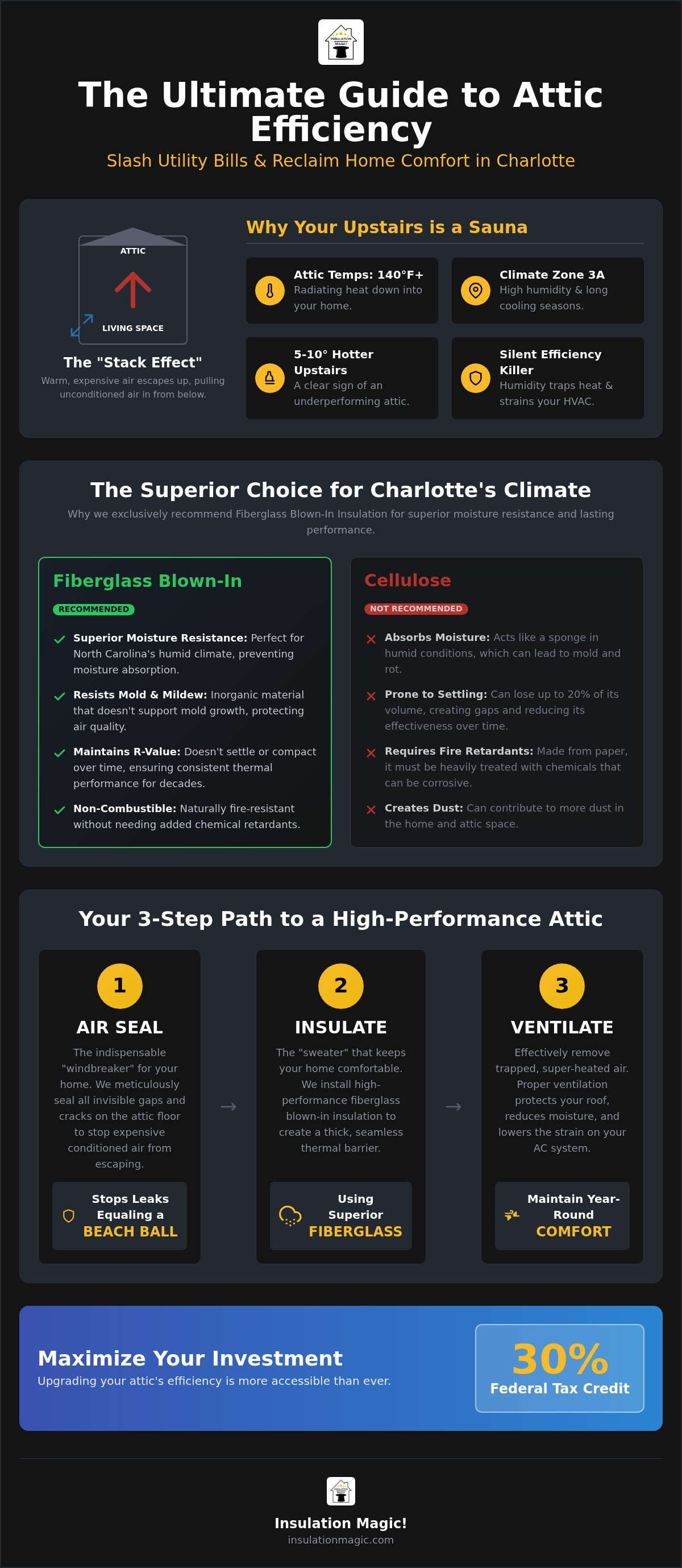
Charlotte summers aren't just hot; they're heavy. As a homeowner in Mecklenburg County, you're living in IECC Climate Zone 3A, a region defined by high humidity and long cooling seasons. The primary reason most homeowners struggle with comfort is a phenomenon called the Stack Effect. This process occurs when warm air rises and escapes through the top of your house, creating a vacuum that pulls outside air in through lower levels. In the summer, your attic acts like a massive radiator, reaching temperatures of 140 degrees or higher and pushing that heat directly into your living space. Understanding how to improve attic energy efficiency Charlotte starts with recognizing that your home is a living system that needs to breathe correctly without losing money.
Many people believe that simply adding more layers of material will solve the problem. However, depth isn't the only metric that matters. You could have three feet of material in your rafters, but if the floor isn't sealed, air will still bypass the barrier. Think of it like wearing a thick wool sweater on a windy day; the wool provides warmth, but without a windbreaker, the cold air blows right through the fibers. This is why a thorough understanding of building insulation materials is vital. While various options exist, we consistently find that fiberglass blown-in provides the best balance of thermal resistance and airflow management for our local climate. If you notice hot ceilings during the afternoon or rooms that feel drafty even when the windows are shut, your attic is likely underperforming.
The Impact of High Humidity on Home Comfort
Moisture is a silent efficiency killer in North Carolina. High attic humidity traps heat, making it harder for your home to cool down even after the sun sets. This puts an immense strain on your HVAC system, often shortening its lifespan because it never gets a break. In communities like Matthews and Waxhaw, it's common to find second floors that stay 5 to 10 degrees hotter than the main level. This isn't just a quirk of the house; it's a sign that your attic isn't effectively blocking the radiant heat transfer from the roof deck.
Defining the Thermal Envelope
The thermal envelope is the physical barrier between the conditioned air inside your home and the unconditioned air outside. Your attic floor is the most vulnerable part of this envelope because it's the primary line of defense against the hottest part of your property. Invisible leaks around recessed lights, plumbing stacks, and wall top plates act like a series of small, open windows. For a typical Charlotte ranch or two-story home, these combined gaps can equal the size of a large beach ball, leading to a significant financial cost on every utility bill. Learning how to improve attic energy efficiency Charlotte requires a meticulous approach to finding and sealing these hidden exit points before refreshing your insulation.
The Critical First Step: Air Sealing the Attic Floor
Imagine wearing a thick wool sweater on a windy day at Romare Bearden Park. While the wool is heavy, the cold breeze cuts right through the fibers. This is exactly how insulation behaves without air sealing. If you want to know how to improve attic energy efficiency Charlotte, you have to start with the "windbreaker" layer. Air sealing is the methodical process of closing the gaps where your expensive, conditioned air escapes into the attic. Without it, your new insulation is just a filter for escaping air.
Common invisible leak points include recessed lights, plumbing stacks, and the top plates of your interior walls. These gaps allow air to bypass your thermal barrier entirely, moving from your living space into the attic. Beyond energy loss, these leaks carry moisture. In our humid climate, this moisture often leads to mold growth on your roof decking or rafters. By sealing these holes with professional grade materials, we protect your home’s structure and your family’s health. You can learn more about this process in our guide on Home Air Sealing: The Invisible Secret to Lower Utility Bills in 2026.
Where Your Money is Escaping
The biggest culprit in many local homes is the "bypass" effect. Recessed light fixtures often act like small chimneys, sucking cold air out of your kitchen or living room. Another major offender is the attic hatch or pull down stairs. Most homeowners overlook this giant hole in their ceiling, yet it’s often the largest single leak in the house. Sealing these areas doesn't just lower bills; it keeps attic dust and fiberglass particles from drifting down into your bedrooms. This results in a cleaner, healthier environment for your children and pets.
Why Removal Matters Before Sealing
Many companies try to seal an attic by simply pushing aside old, dusty material. This is rarely effective because you can't seal what you can't see. To achieve a meticulous, craftsman level seal, you need to work on a clear surface. Starting with a clean slate allows us to identify every hairline crack in the top plates where air might be escaping. This attention to detail is the foundation of how to improve attic energy efficiency Charlotte for the long term. If your current attic is filled with decades of debris or animal waste, check out our Professional Insulation Removal in Charlotte: The Homeowner’s Essential Guide to see why a fresh start is the only way to guarantee results. If you're ready for a thorough assessment of your home's envelope, you can schedule a visit with our team to get started.
Fiberglass Blown-In: The Superior Choice for Charlotte Homes
Once your attic floor is air-sealed, the next step in how to improve attic energy efficiency Charlotte is selecting the right material to maintain your home's thermal barrier. While some contractors offer a variety of options, we've found that fiberglass blown-in insulation is the only choice that meets our standards for meticulous craftsmanship. Unlike other materials, fiberglass is naturally fire-resistant and doesn't rely on heavy chemical treatments to keep your family safe. It also handles our local humidity better than paper-based alternatives, ensuring your home stays dry and comfortable year-round.
We also choose to avoid spray foam for residential attics. While it's a popular trend, spray foam can create a "hot roof" that traps moisture against your roof decking, potentially leading to rot that stays hidden for years. Our approach focuses on a safer, breathable system that protects your property's structural integrity while maximizing comfort. This attention to detail is essential when considering how to improve attic energy efficiency Charlotte for a lifetime of savings.
Fiberglass vs. Cellulose: The Real Winner
The primary reason we recommend fiberglass over cellulose is long-term performance. Cellulose insulation is made of recycled paper, which is prone to settling over time. Industry data suggests that cellulose can lose up to 20% of its initial R-value as it packs down, leaving your home less protected than the day it was installed. Fiberglass blown-in is much more stable; it stays fluffy and maintains its depth for decades. Additionally, fiberglass is a cleaner product. It doesn't create the fine, gray dust associated with cellulose, and it won't leave your home with a lingering chemical smell.
Achieving the Right R-Value for NC
In North Carolina, the building code requires a minimum of R-38, but for families looking to maximize their savings, we recommend aiming for R-49 or R-60. To achieve these levels, you need specific depths of material, often 15 to 20 inches of fiberglass. This depth ensures that heat cannot easily penetrate the floor and enter your rooms below. During the installation, we pay close attention to every nook and cranny, ensuring a consistent blanket of protection. We also install baffles at the eaves. These simple but vital components prevent the insulation from blocking your soffit vents, allowing your attic to breathe while staying thermally protected. This balanced approach is the hallmark of a quality installation that stands the test of time.
Managing the Heat: Attic Ventilation and Fans
While air sealing and fiberglass insulation provide the barrier your home needs, ventilation is the exhaust system that keeps that barrier from being overwhelmed. Most Charlotte homes rely on passive ventilation. This system uses soffit vents under the eaves to pull in fresh air and ridge vents at the peak of the roof to let hot air escape. It's a simple, natural process, but during a sweltering July afternoon, natural convection often struggles to keep up. When heat builds up to extreme levels, it radiates through your insulation and into your living space, forcing your air conditioner to work overtime. Learning how to improve attic energy efficiency Charlotte requires looking beyond just the floor; you must also manage the air above it.
By actively removing that trapped heat, you significantly reduce the load on your HVAC system. A cooler attic means your AC compressor doesn't have to cycle as frequently to maintain your desired temperature. This doesn't just save you money on your monthly bill; it extends the life of your expensive cooling equipment. For a deeper look at these dynamics, see our guide on How to Lower Heating and Cooling Costs: A Homeowner’s Guide to Permanent Savings.
Is an Attic Fan Right for You?
In many local homes, passive vents simply aren't enough to handle the sheer volume of heat generated by the North Carolina sun. This is where an attic fan becomes a game changer. We recommend temperature-controlled fans that only activate when the attic reaches a specific threshold, typically around 90 or 100 degrees. This ensures you aren't wasting electricity when the attic is already cool. You have two main options: solar and electric. Solar fans are excellent for energy conscious homeowners because they cost nothing to operate, though they only run when the sun is shining. Electric fans provide consistent, high-volume airflow regardless of the weather, which can be vital during our humid summer nights.
The Synergy of Insulation and Airflow
Think of insulation and ventilation as a partnership. Insulation keeps the heat out of your bedrooms, while ventilation moves that heat away from your house entirely. This synergy is also your best defense against moisture. During humid nights, stagnant air in an attic can lead to condensation on the underside of your roof. Proper airflow prevents this buildup, protecting your rafters from rot. As a craftsman tip, we always recommend checking your soffit vents. It's very common to find them obstructed by old debris or improperly installed material from previous contractors. Ensuring these intake points are clear is a simple but essential part of how to improve attic energy efficiency Charlotte.
Taking Action: Your Path to a More Efficient Home
Improving your home's performance doesn't have to be a mystery. If you're wondering how to improve attic energy efficiency Charlotte, the best way to start is with a simple visual audit. Carefully peek into your attic and look for "peaks and valleys" in your current insulation. If you can see the wooden floor joists, your R-value is likely far below the modern standard. Next, gather your utility bills from the last 12 months. Look for sharp spikes in July and August. These are clear indicators that your attic is failing to block the radiant heat from the North Carolina sun.
The financial case for these upgrades is compelling. Industry research shows that professional air sealing and insulation can offer a return on investment as high as 117%. Beyond the immediate comfort of a balanced home, you can expect to save between 15% and 25% on your monthly heating and cooling costs. It's a project that essentially pays for itself through permanent savings and the preservation of your HVAC system's longevity. By following this methodical path, you move from guessing about your home's comfort to controlling it.
The Insulation Magic! Difference
We believe in a "Patient Educator" approach. We don't just tell you what's wrong; we show you the science of how your home is losing money. Our team takes pride in meticulous detail, ensuring every top plate is sealed and every baffle is perfectly placed before we blow in our premium fiberglass insulation. We consistently recommend fiberglass blown-in over cellulose because it doesn't settle and it maintains its thermal integrity for decades. This provides the long-term protection your family deserves without the dusty residue of paper-based products. You can see the results of our craftsman-style work by visiting our Insulation Magic! Reviews page.
Ready to Book Your Attic Refresh?
Whether you live in Ballantyne, Weddington, or Mint Hill, your home has unique needs based on its construction and orientation. During a professional assessment, we'll walk you through a custom plan for how to improve attic energy efficiency Charlotte in your specific property. We'll identify the invisible leaks we discussed earlier and determine the exact depth of fiberglass needed to reach R-49 or R-60. This meticulous planning is how we guarantee a transformation you can actually feel. We treat every attic as if it were our own, ensuring a clean, orderly, and effective installation from start to finish.
Take Control of Your Home’s Climate Today
Reclaiming your home's comfort starts with a shift in perspective. You've learned that true efficiency requires more than just a layer of material; it demands a meticulous approach to air sealing and active ventilation. By prioritizing fiberglass blown-in insulation, you're choosing a solution designed for maximum longevity and resistance to the settling issues that plague cellulose. This craftsman-led strategy ensures your R-value stays consistent for decades while protecting your property from the unique humidity challenges of North Carolina.
Our team has provided local Charlotte expertise since 2026, focusing on transparent communication and methodical installations that treat your home with the care it deserves. We don't just perform a task; we provide the peace of mind that comes from knowing every invisible leak is sealed and your thermal envelope is secure. Understanding how to improve attic energy efficiency Charlotte is the first step toward lower utility bills and a more predictable monthly budget.
We look forward to helping you transform your attic into a high-performing asset for your home. Your journey to a cooler, more efficient living space is just one appointment away.
Frequently Asked Questions
How much does it cost to improve attic insulation in Charlotte?
Professional attic insulation in Charlotte usually costs between $1,654 and $2,433 depending on your square footage. If you need old material removed, expect an additional $1 to $1.50 per square foot for that service. These figures represent industry averages for our region. Investing in these upgrades is a smart way to manage how to improve attic energy efficiency Charlotte while increasing your home's resale value and long term comfort.
Is fiberglass better than cellulose for North Carolina attics?
Fiberglass blown-in is the superior choice for North Carolina's humid climate. Unlike cellulose, which is made of recycled paper and can settle by 20%, fiberglass maintains its loft and R-value for decades. It's naturally moisture-resistant and doesn't require the heavy chemical fire retardants found in cellulose. This makes it the cleanest, most reliable option for homeowners who value a meticulous, long-lasting installation that won't degrade over time.
Can I just put new insulation over the old stuff?
While you can technically add new layers over old material, we strongly advise against it. Removing old insulation is the only way to perform a thorough air seal on the attic floor. This "clean slate" approach allows us to find and seal every hidden gap around light fixtures and plumbing stacks. It ensures your new fiberglass performs at its full potential without being bypassed by escaping air from the rooms below.
How do I know if my attic needs air sealing?
You'll know your attic needs sealing if your second floor is significantly warmer than your first or if you notice "dirty" spots in your current insulation. These dark areas act like a filter, catching dust as conditioned air leaks into the attic through gaps in your ceiling. Identifying these invisible exit points is a critical part of how to improve attic energy efficiency Charlotte and creating a true thermal barrier.
Will an attic fan really lower my electric bill?
An attic fan definitely helps lower your bills by actively exhausting stagnant, 140-degree air. This reduces the radiant heat pushing down into your living space, which means your air conditioner doesn't have to work as hard to maintain a cool temperature. By lowering the cooling load on your compressor, you save money every month and extend the life of your HVAC system. It's a proactive way to manage intense summer heat.
How long does the attic insulation process take?
A professional attic refresh typically takes one to two business days to complete. The first day often focuses on the meticulous removal of old material and detailed air sealing of the attic floor. The second day involves installing baffles for proper ventilation and blowing in the new fiberglass. We work efficiently to restore your home's comfort while maintaining a clean and orderly workspace throughout the entire sequence of events.
Are there Duke Energy rebates for attic insulation in 2026?
Homeowners should check Duke Energy’s website for specific 2026 rebate availability, as local programs can change. However, you can currently take advantage of the federal Residential Clean Energy Credit. This provides a 30% tax credit for insulation and air sealing costs, capped at $1,200 annually. It’s a significant incentive that’s confirmed to be available through 2032, making it the perfect time to upgrade your home’s thermal envelope and overall efficiency.
Why shouldn’t I use spray foam in my attic?
We avoid spray foam in residential attics because it can trap moisture against your roof's wooden structure, leading to hidden rot. It also creates a "hot roof" by removing the ventilation space your shingles need to stay cool. Our fiberglass-focused approach allows your home to breathe naturally while providing an elite thermal barrier. This craftsman-led method protects your property’s structural integrity and ensures a safer, healthier indoor environment for your family.
Disclaimer
This blog is intended to provide general information about insulation, energy efficiency, and home comfort based on years of experience. While we strive to keep content accurate and up to date, results may vary based on your home's construction, condition, and climate. Contact Insulation Magic for a personalized assessment and recommendations.


