
Did you know that up to 50% of the air you breathe on your home's first floor actually originates from the dark, damp area beneath your feet? If you're struggling with itchy eyes and persistent sneezing even with the windows shut, your foundation might be the hidden culprit. In our humid Charlotte climate, an open crawlspace is often a breeding ground for mold and dust mites. Choosing crawlspace encapsulation for allergies is a methodical way to stop these triggers at the source and finally breathe easier.
It's exhausting to deal with musty odors and high humidity that make your living space feel uncomfortable. We believe your home should be a sanctuary, not a source of stress. This guide will walk you through how sealing your crawlspace breaks the "stack effect," which is the natural process that pulls allergens upward into your family's lungs. You'll learn how a clean, dry environment, supported by high quality fiberglass insulation rather than dusty cellulose, can significantly reduce indoor allergens and even lower your monthly utility bills. Let's look at how a professional, craftsman-led approach to your crawlspace can restore your peace of mind.
Key Takeaways
- Learn how the "stack effect" pulls hidden allergens from your home's foundation directly into your family's breathing air.
- Discover why crawlspace encapsulation for allergies is the most effective way to stop mold spores and dust mites at their source.
- Find out why professional insulation removal is a critical first step and why clean fiberglass blown-in is the superior choice for a healthy home.
- Understand the difference between a basic vapor barrier and a full encapsulation system for maintaining a dry, odor-free environment.
- Explore a meticulous, spray-foam-free approach to sealing your crawlspace that prioritizes your family's long-term health and comfort.
Why Your Charlotte Crawlspace is an Allergy Trigger
Your home acts like a living, breathing organism, and the air it "inhales" often comes from the least healthy place on the property. To understand why you can't stop sneezing even when your windows are locked tight, we first have to look at the structure itself. What is a Crawlspace? In most Charlotte homes, it's the shallow area between the ground and your first floor. While it serves a structural purpose, an open or vented crawlspace is essentially a factory for microscopic triggers. Because the floor is often just raw dirt, it constantly releases moisture and organic spores into the air trapped beneath your joists. Since wood subfloors and floorboards are surprisingly porous, these allergens don't stay hidden; they migrate directly into your living room.
The Science of the Stack Effect
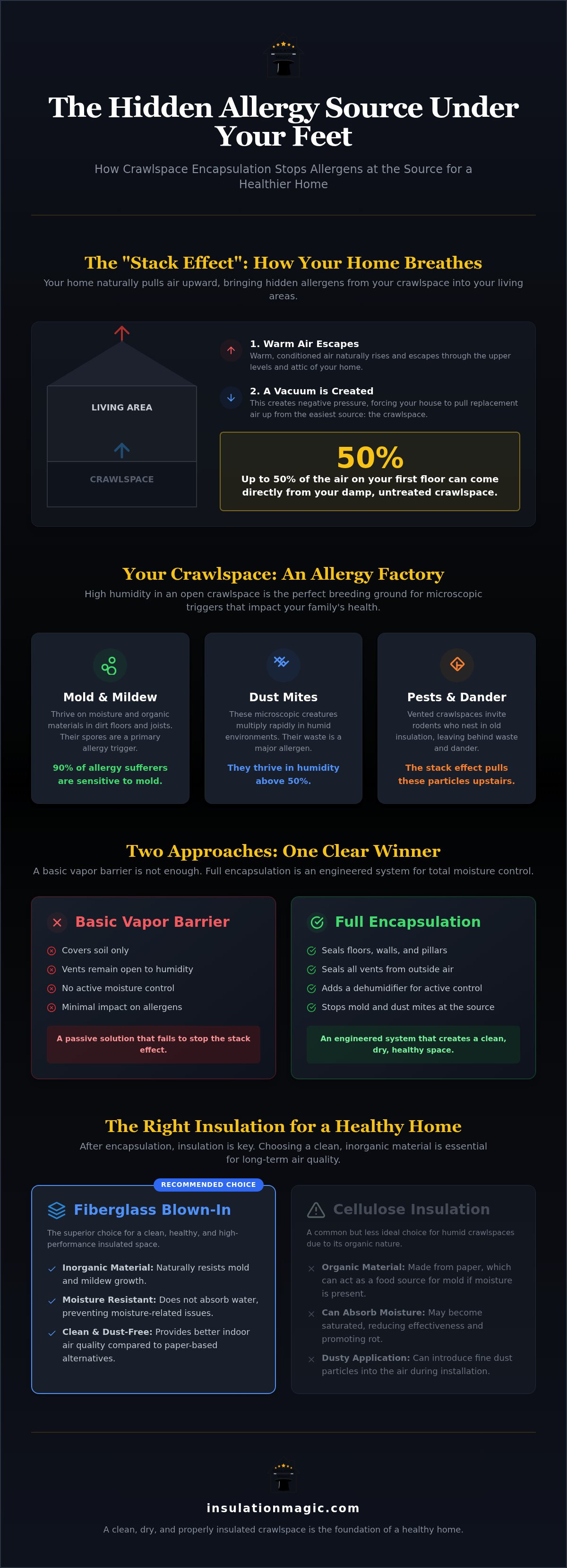
Physics plays a frustrating role in your home's air quality through a process called the "stack effect." Warm air naturally rises and escapes through your attic. As this air leaves, it creates a vacuum in the lower levels of your home. To fill that void, your house sucks air upward from the foundation. In our humid North Carolina climate, this effect is especially aggressive during the summer. This means up to 50% of the air you breathe in your bedroom could have originated in that damp, dark space under your feet. This constant upward pull is why crawlspace encapsulation for allergies is such a vital investment; it physically severs the connection between the dirt floor and your lungs.
Common Crawlspace Allergens
A damp crawlspace provides the perfect environment for a variety of health triggers to thrive. When humidity levels stay high, your home becomes a sanctuary for pests and fungi that wouldn't survive in a dry environment. Here are the primary culprits we find during our assessments:
- Mold and Mildew: These thrive on the organic material found in floor joists and dirt floors. Research shows that 90% of people with allergies have a sensitivity to mold spores.
- Dust Mites: These microscopic creatures love humidity over 50%. Their waste is responsible for a massive portion of the allergic components found in common house dust.
- Rodent Waste: Traditional fiberglass batts in a vented crawlspace often become nesting grounds. Over time, these batts act as filters that trap dander and waste, which the stack effect then pulls into your home.
When you're considering crawlspace encapsulation for allergies, you're looking at more than just a plastic liner. You're looking at a methodical way to dry out these habitats and stop the cycle of dampness that allows these triggers to multiply. By sealing the vents and treating the space like a conditioned part of the home, you can finally reclaim your indoor air quality.
What is Crawlspace Encapsulation and How Does It Work?
If you've ever looked under your home and seen a thin, loose piece of black plastic resting on the dirt, you've seen a basic vapor barrier. While a standard 6-mil barrier is often a building code requirement, it's rarely enough to stop the "stack effect" that pulls allergens into your living space. Crawlspace encapsulation is a much more thorough, engineered approach. It transforms your foundation from a damp, vented cave into a clean, conditioned part of your home's envelope. This system doesn't just cover the ground; it wraps the foundation walls and seals every exterior vent to create a permanent shield against outdoor humidity and soil gases.
The Components of a Sealed System
A professional encapsulation involves several high-performance layers. We use reinforced polyethylene liners, typically between 12 and 20 mils thick. These aren't like the flimsy plastic sheets found at big-box stores; they're puncture-resistant and designed to remain durable for decades. Every seam is overlapped and taped with precision, and the liner is mechanically fastened to the foundation walls. This creates a bright, white, "dry-room" environment that looks and feels more like a finished basement than a crawlspace. Once the space is airtight, a dedicated dehumidifier becomes the heart of the system. This provides active moisture control, keeping the relative humidity consistently below 50%. This is the magic number where mold stops growing and dust mites can't survive.
Vapor Barrier vs. Full Encapsulation
Many homeowners find these terms confusing, but the difference is significant for your health. A basic vapor barrier is a passive solution that only covers the soil. It won't stop humid air from blowing in through vents or moisture from seeping through porous concrete walls. For true relief, crawlspace encapsulation for allergies is the only real answer. It involves sealing those vents and often updating your crawlspace insulation services to ensure the space remains thermally stable. By removing old, sagging fiberglass and sealing the entire area, we eliminate the "filter" that traps dust and rodent waste. If you're ready to see how this meticulous process can change your home's environment, you can start with an easy online booking for a professional assessment. We take pride in guiding you through each step so you understand exactly how your home's air quality is being protected.
The Health Benefits: How Encapsulation Stops Allergy Symptoms
When we finish a project, homeowners often report an immediate difference in how their home smells and feels. The heavy, damp sensation in the air disappears, replaced by a crispness that makes breathing feel effortless. This isn't just a psychological change; it's the result of physically blocking the triggers that have been migrating into your living space for years. By choosing crawlspace encapsulation for allergies, you're effectively turning off the tap for mold spores and dust mite waste at their primary source. Your home's air quality is no longer at the mercy of the dirt and dampness beneath your floorboards.
Musty odors are more than just a nuisance; they're a sign of active microbial growth. These smells often linger in furniture, carpets, and even the clothes in your closet. When the crawlspace is dry and sealed, these odors vanish because the biological processes creating them have stopped. Your home starts to smell like your home again, rather than a damp basement. This clean air also benefits your HVAC system. It's much easier for your equipment to circulate and cool dry air, which reduces wear and tear and prevents the system from spreading allergens through your ductwork.
Breaking the Mold Cycle
Mold requires three things to thrive: food, warmth, and moisture. Your wooden floor joists provide the food and warmth, but encapsulation removes the moisture. Without that third element, mold cannot survive or reproduce. This stops the cycle of spore production that irritates your respiratory system. You'll likely notice a cleaner home overall; homeowners often see a reduction in the fine dust that settles on surfaces. Much of that "dust" is actually organic material and spores pulled up from the foundation, and sealing the space keeps it where it belongs: outside.
Pest Prevention and Allergen Control
Traditional vents are open invitations for cockroaches, spiders, and rodents. These pests carry their own set of potent allergens, including dander and waste products that contribute to poor indoor air quality. Our meticulous sealing process creates a physical barrier that these intruders can't easily bypass. By closing off vent openings and wrapping the foundation in a thick, reinforced liner, you create a foundation that is clean, bright, and dry. This transformation provides immense peace of mind, knowing that the area under your feet is no longer a hidden sanctuary for pests or allergens. It's a methodical approach that prioritizes your family's long-term health and comfort.
The Role of Clean Insulation in Allergy Relief
Many homeowners think that sealing a crawlspace is strictly about the plastic liner on the ground. However, if you seal a foundation while leaving behind decades of contaminated materials, you're essentially trapping a health hazard inside your home's envelope. Old fiberglass batts in a vented crawlspace are notorious for acting like giant air filters. Over the years, they trap microscopic dust, pollen, and rodent waste. When the stack effect pulls air upward, it draws these particles right through your floorboards. This is why we treat the insulation as a vital component of the air quality equation rather than just a way to keep your toes warm.
Why Removal Comes Before Encapsulation
We believe that professional insulation removal is a mandatory first step for anyone seeking true relief from indoor triggers. Our "Meticulous Craftsman" approach starts with a completely sanitized, empty space. We don't just pull down the old material; we ensure that the wood floor joists are inspected and cleaned. If you leave old, soggy insulation in place, you risk trapping active mold spores behind your new vapor barrier. Starting with a blank canvas is the only way to guarantee that your crawlspace encapsulation for allergies is actually creating a healthy environment instead of just hiding a problem.
Choosing the Right Materials
Once the space is clean and sealed, the type of insulation you choose to reinstall will dictate your long-term air purity. We consistently recommend fiberglass blown-in insulation as the superior choice for North Carolina homes. Unlike cellulose, which is made from ground-up recycled paper and can create significant dust, fiberglass is an inert material that doesn't provide a food source for mold. It's a cleaner option for families who are sensitive to airborne particulates. We also make it a point to avoid spray foam insulation. While popular, spray foam can lead to chemical off-gassing and makes it nearly impossible to inspect for future termite activity or wood rot.
To achieve the best results, we pair clean fiberglass with thorough home air sealing. This combination ensures that your home is thermally efficient while maintaining the highest possible air standards. By choosing crawlspace encapsulation for allergies and using the right materials, you're investing in a system that protects your respiratory health for years to come.
Professional Encapsulation in Charlotte: The Insulation Magic! Way
When you choose a local partner for your home health project, you deserve more than a generic service. Insulation Magic! is an independent business operated by Chris, which means every seal, every strip of tape, and every liner is installed with the meticulous care of a craftsman. We don't believe in the high-pressure sales tactics used by large franchises. Instead, we focus on providing a thorough, spray-foam-free environment that prioritizes your family's peace of mind. For many homeowners, crawlspace encapsulation for allergies is a major decision, and we're here to ensure the process is transparent and methodical from start to finish.
Our commitment to being spray-foam-free is a deliberate choice for the health of your home. While spray foam is common in the industry, it can lead to chemical off-gassing that sensitive individuals find irritating. It also creates a permanent barrier that hides the foundation and wood sills, making it impossible to perform future termite inspections or check for hidden wood rot. By using high-quality reinforced liners and focusing on mechanical drying, we achieve a superior result without the risks associated with chemical foams. It's a cleaner, safer way to protect your foundation while ensuring your indoor air remains pure.
A Healthier Home for Your Family
Serving the Charlotte metro area, including Waxhaw and Matthews, gives us a unique understanding of the specific humidity challenges in the Carolinas. We don't just "install plastic"; we tailor each system to handle the heavy moisture loads common in our region. Chris takes a "patient educator" approach with every client, walking you through the "how" and "why" of the process so you feel confident in the solution. We want you to understand how your new system will break the cycle of dampness and mold. You can see the real-world impact this has had on local families by reading through our customer reviews, where we've helped many neighbors reclaim their home's comfort.
Take the First Step Toward Relief
If you're ready to stop the sneezing and finally address those musty odors, the first step is a professional assessment. During our visit, we'll perform a thorough inspection of your foundation, checking for moisture levels, old contaminated insulation, and potential pest entry points. We'll provide you with a clear, honest plan that focuses on long-term home health rather than a quick fix. To prepare for our visit, simply ensure the access point to your crawlspace is clear and that any heavy storage items are moved away from the opening. We'll handle the rest, guiding you toward a dry, clean foundation that supports a healthier life.
Choosing crawlspace encapsulation for allergies is an investment in your family's daily well-being. By removing the hidden triggers beneath your feet and replacing them with a clean, sealed environment, you can finally breathe easier in your own home. Our team is ready to provide the meticulous service and local expertise you need to transform your crawlspace for good.
Your path to a healthier home begins with one methodical step. We look forward to helping you protect your property and your peace of mind.
Frequently Asked Questions
Can crawlspace encapsulation really help with my asthma?
Yes, encapsulation can significantly help with asthma by eliminating the damp environments where mold and dust mites thrive. Since the stack effect pulls air from your foundation into your living space, removing these triggers at the source reduces the respiratory load on your family. Research indicates that dampness and mold in homes are attributable to 21% of current asthma cases, making a dry foundation a critical health priority.
How long does the encapsulation process take for a typical Charlotte home?
A typical crawlspace encapsulation in a Charlotte home usually takes between two and four days to complete. The exact timeline depends on the size of your crawlspace and the amount of preparation needed, such as removing old insulation or cleaning the floor joists. We take a methodical approach to ensure every seal and seam is perfect, so we don't rush the process at the expense of quality.
Will encapsulation make my floors warmer in the winter?
Yes, you will notice that your floors feel much warmer during the winter months after the encapsulation is finished. By sealing the foundation vents and air sealing the floor joists, we stop cold winter air from circulating directly beneath your feet. This creates a thermally stable environment that keeps your first floor comfortable and reduces the strain on your heating system.
Do I need to remove my old insulation before encapsulating?
We always recommend removing old insulation as a mandatory first step before starting the encapsulation process. Old fiberglass batts in a vented crawlspace often trap moisture, dust, and rodent waste, which can lead to lingering odors and health issues. Starting with a sanitized, empty foundation ensures that your new system isn't trapping old allergens against your home's wooden structure.
How often does a crawlspace dehumidifier need maintenance?
Your crawlspace dehumidifier typically needs a filter check every six months and a more thorough professional inspection once a year. Maintaining the unit is simple but vital for keeping the relative humidity below 50%. A well-maintained dehumidifier ensures the air remains dry enough to prevent mold growth and keeps the mechanical drying system running efficiently for the long term.
Is encapsulation worth the cost if I'm not currently seeing mold?
Encapsulation is absolutely worth the investment even if you don't see visible mold yet, as it serves as a powerful preventative measure. High humidity levels in the Carolinas can lead to wood rot and structural damage long before mold becomes obvious to the naked eye. Proactively sealing your space protects your home's equity and ensures your indoor air quality remains high before a problem starts.
What is the difference between a vapor barrier and encapsulation for allergies?
The main difference is that a vapor barrier only covers the dirt floor, while crawlspace encapsulation for allergies involves sealing the walls and vents while adding a dehumidifier. A basic plastic sheet on the ground won't stop humid air from entering through vents or moisture from seeping through foundation walls. Encapsulation creates a fully conditioned room that provides the highest level of protection for your lungs.
Does crawlspace encapsulation help keep pests out of my house?
Yes, encapsulation creates a formidable physical barrier that helps keep pests like cockroaches, spiders, and rodents out of your house. By sealing the exterior vents and wrapping the foundation in a heavy, reinforced liner, you eliminate the easy entry points these intruders use. A dry, clean environment is also much less attractive to pests that seek out damp, dark spaces to nest.
Disclaimer
This blog is intended to provide general information about insulation, energy efficiency, and home comfort based on years of experience. While we strive to keep content accurate and up to date, results may vary based on your home's construction, condition, and climate. Contact Insulation Magic for a personalized assessment and recommendations.


