
What if the reason you're wearing three pairs of socks indoors has nothing to do with your thermostat settings? It's a common struggle for homeowners in the Greater Charlotte area, where damp air and poorly managed crawlspaces turn beautiful hardwood into an icy tundra. You've likely noticed that even when the furnace is running, your feet stay freezing and your monthly utility costs continue to climb. Finding a permanent cold floors above crawlspace fix isn't just about comfort; it's about stopping the "stack effect" that pulls cold, unconditioned air directly into your living room.
I understand how stressful it is to feel like you're losing the battle against drafts and high energy bills. The good news is that you can achieve warm, comfortable floors without resorting to chemical-heavy spray foam. In this guide, we'll walk through five professional, spray-foam-free methods to seal your home's envelope and protect your crawlspace. You'll discover how a meticulous approach to air sealing and moisture control can lower your bills and create a much healthier environment for your family to enjoy.
Key Takeaways
- Understand how the "Stack Effect" creates a vacuum in your home, pulling freezing air from the crawlspace directly through your floorboards.
- Identify the most reliable cold floors above crawlspace fix by combining meticulous air sealing with professional crawlspace encapsulation.
- Learn why fiberglass blown-in insulation is the superior, chemical-free choice for maintaining long-term thermal performance and protecting your home's air quality.
- Discover why addressing both your attic and crawlspace as a single system is the only way to permanently eliminate drafts and lower monthly utility costs.
- Follow a methodical, craftsman-led restoration process that replaces damaged materials with clean, high-performance solutions for a warmer living environment.
Understanding Why Floors Above Crawlspaces Get So Cold
In the Greater Charlotte area, our red clay soil holds onto moisture like a sponge, creating a damp microclimate directly beneath your feet. Many homeowners assume that if they have insulation under their floorboards, they've done enough. However, finding a permanent cold floors above crawlspace fix requires looking deeper than just the material itself. The air in a crawlspace is often a dozen degrees colder than your living room, and without a meticulous barrier, that cold is constantly migrating upward.
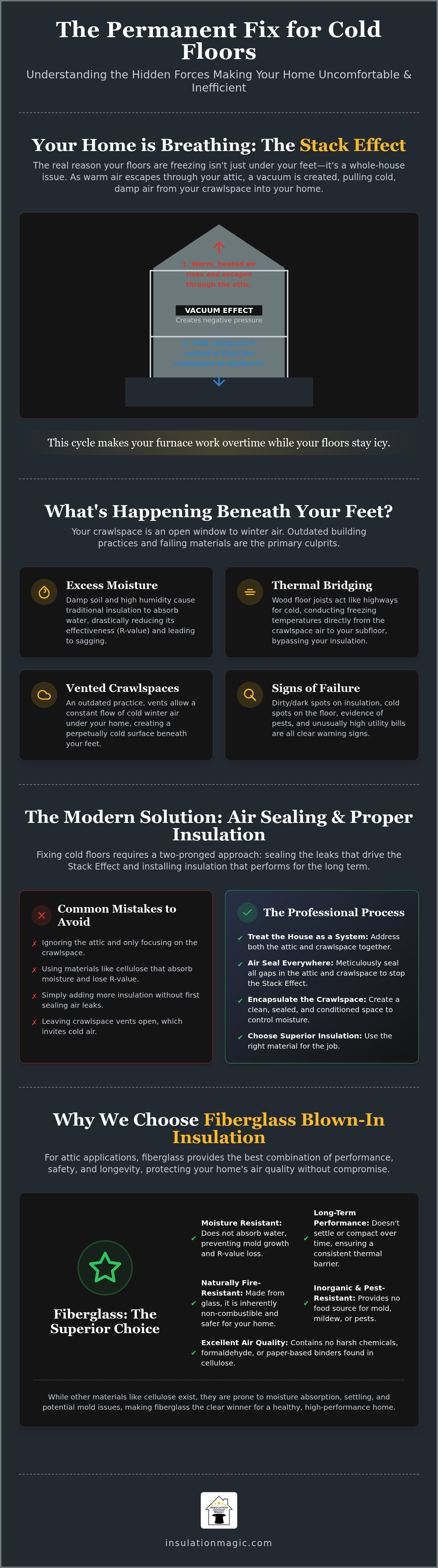
One of the biggest culprits is a phenomenon called thermal bridging. Even if you have thick insulation between your floor joists, the wood joists themselves act as thermal bridges. Wood is a much better conductor of heat than insulation is; it carries the freezing temperatures from the crawlspace directly to your subfloor. This is why your floors might feel icy even if you've recently added "pink" batts. Without proper air sealing to stop the movement of air, the wood joists continue to bypass your thermal protection.
Moisture plays a devastating role in this process as well. When humidity levels in North Carolina rise, traditional insulation materials can absorb water vapor. This is critical because Building insulation relies on trapped air pockets to resist heat flow. When those pockets fill with moisture, the R-value, or insulating power, plummets. Damp insulation also becomes heavy, leading it to sag and pull away from the subfloor. These small air gaps allow cold drafts to swirl directly against the underside of your floorboards, rendering the insulation almost useless.
The Problem with Traditional Vented Crawlspaces
For decades, building codes required vents to allow moisture to escape. We now know this is yesterday's science. In the winter, these vents serve as open windows that invite freezing air to circulate under your home. This air infiltration is often the primary reason for a cold floors above crawlspace fix being necessary. Local humidity doesn't just make the air feel heavy; it actively degrades older materials, turning a once-protective barrier into a soggy, sagging mess that fails to stop the winter chill.
Signs Your Current Floor Insulation is Failing
You don't always need to crawl under the house to know there's a problem. Look for these specific indicators of failure:
- Dirty Insulation: If your fiberglass looks grey or black in certain spots, it's acting as a filter for air leaks. This is a clear sign of air infiltration.
- Temperature Gaps: Use your feet to feel the difference between the center of a room and the edges. Cold perimeters usually indicate air is coming up through the wall cavities.
- Rodent Activity: Sagging batts create perfect "tunnels" for pests, which further destroys the material's integrity.
- High Utility Bills: If your furnace is constantly cycling but the floor stays cold, your crawlspace is likely "stealing" your expensive heated air.
At Insulation Magic!, we believe in a thorough assessment before any work begins. We prioritize high-quality fiberglass blown-in solutions for attics and meticulous crawlspace work because these materials provide the longevity and safety our neighbors in Waxhaw and Weddington deserve.
The Stack Effect: How Your Attic Affects Your Crawlspace
To solve the mystery of your chilly toes, we have to look up before we look down. Most homeowners don't realize that their attic and crawlspace are actually part of the same breathing system. This connection is driven by a phenomenon known as the Stack Effect. The Stack Effect is a pressure-driven cycle of energy loss. As the warm air you pay for rises and escapes through the top of your house, it creates a vacuum that pulls freezing air through every crack in your subfloor.
Think of your home like a chimney. During a cold Charlotte winter, the heated air inside is lighter and more buoyant than the dense air outside. This warm air naturally searches for an exit, finding it in recessed lights, attic hatches, and unsealed top plates. Research into conditioning ventilated crawlspaces shows that as this air leaves, your home must replace it. It pulls that replacement air from the path of least resistance, which is almost always your crawlspace. This is why a cold floors above crawlspace fix must involve the entire house, not just a few batts of insulation under the floorboards.
Why Air Sealing is the First Step
Before we ever talk about adding new materials, we focus on the invisible leaks. These "bypasses" are hidden gaps around plumbing stacks, electrical wires, and HVAC registers. Without professional home air sealing, your floor is essentially an open sieve. Every time a wire runs from your crawlspace to your attic, it passes through a hole in the wood framing. If these aren't sealed with the precision of a craftsman, they act like small vacuums. They constantly suck up cold, damp air, which is why your floors feel drafty even in well-insulated rooms. We take the time to find these penetrations, ensuring that the "vacuum" is turned off for good.
The Whole-Home Thermal Envelope
Creating a balanced thermal envelope means treating the top and bottom of your house as a single unit. In homes across Matthews and Ballantyne, we often find that the attic is just as much to blame for a cold floor as the crawlspace itself. By sealing the attic and then installing high-performance fiberglass blown-in insulation, we stop the upward escape of heat. We always prioritize air sealing as a prerequisite because it is a waste of resources to put new insulation over an active leak. Once the pressure is stabilized, the drafts stop and your heating system doesn't have to work overtime to fight the Stack Effect. If you are ready to stop the cycle of energy loss, you can book a professional assessment with our team to identify your home's unique pressure points.
Comparing Fixes: Fiberglass vs. Other Materials
When you're searching for a permanent cold floors above crawlspace fix, the sheer number of insulation types can be overwhelming. We believe in using materials that are as safe for your family as they are effective for your home's thermal envelope. While options like cellulose and mineral wool are common, they don't always hold up to the specific demands of a North Carolina crawlspace. Cellulose, for instance, is prone to settling and can absorb moisture like a sponge, which eventually leads to the very sagging issues we discussed earlier. Mineral wool is a dense and effective fire barrier, but it often lacks the versatile coverage needed for complex subfloor geometries.
Our approach centers on high-quality fiberglass. It's a breathable, non-toxic material that provides a stable R-value for decades. By choosing the right materials, we ensure your home remains a healthy environment. We avoid materials that off-gas or create permanent barriers that could trap moisture against your home's wooden skeleton. This focus on safety and longevity is what defines our commitment to your peace of mind.
Why Fiberglass Blown-In Wins for Attic and Floor Performance
Fiberglass blown-in insulation is our preferred choice because it excels at trapping air and maintaining its shape. Unlike traditional batts that often leave small gaps at the edges of floor joists, blown-in material creates a seamless blanket of protection. This is especially important in the Greater Charlotte area, where temperature fluctuations can cause materials to expand and contract. Fiberglass remains stable, resisting the urge to settle or shift over time.
Another practical advantage is the simplicity of professional insulation removal. Home ownership involves maintenance. If you ever need to repair a leaky pipe or run new electrical wires through your floor, fiberglass can be easily moved or removed. It doesn't bond to your floor joists, which means your home's structural components remain accessible and easy to inspect for the life of the property.
The Hidden Dangers of Spray Foam
You won't find us using spray foam in your crawlspace, and for good reason. While it provides an airtight seal, that seal is often too restrictive. If moisture finds its way into your floor joists from a bathroom leak or high humidity, spray foam traps that water against the wood. This creates a hidden environment where rot can flourish completely out of sight.
The "permanent" nature of spray foam is also a significant drawback. It makes it nearly impossible to inspect for termites or structural issues without hacking away at the material. For a meticulous craftsman, being able to see and protect the home's structure is paramount. We prefer breathable solutions that allow your home to "exhale" moisture while still keeping the cold air where it belongs: outside.
Step-by-Step Guide to Fixing Cold Floors for Good
Achieving a permanent cold floors above crawlspace fix requires a disciplined, five-step process that respects the physics of your home. We don't believe in shortcuts or temporary patches. Instead, we follow a methodical plan that addresses the root causes of energy loss while restoring the comfort and health of your living environment. This approach ensures that every dollar you invest provides long-term value for your property in the Greater Charlotte area.
- Step 1: Professional Assessment: We begin by examining both your crawlspace and attic to understand how the Stack Effect is impacting your home's pressure.
- Step 2: Meticulous Removal: We carefully extract old, sagging, or rodent-infested materials to create a clean, sanitary slate for the new installation.
- Step 3: Precision Air Sealing: Using our craftsman-led approach, we seal every plumbing and electrical penetration to stop the "vacuum" that pulls in cold air.
- Step 4: Moisture Management: We install a high-performance vapor barrier or a full encapsulation system to protect your floor joists from North Carolina's humidity.
- Step 5: Thermal Protection: Finally, we add new, high-R-value fiberglass insulation to the thermal boundary, ensuring your floors stay warm and your bills stay low.
Crawlspace Encapsulation vs. Traditional Sealing
While traditional sealing helps, many homeowners in Weddington and Waxhaw find that crawlspace insulation combined with a 20-mil vapor barrier provides the ultimate protection. This heavy-duty encapsulation creates a conditioned space that is much easier to keep warm. When paired with a dedicated dehumidifier, this strategy can lead to a 15% to 20% reduction in energy bills, providing a reliable cold floors above crawlspace fix that stands the test of time.
The Importance of Meticulous Removal
Leaving old insulation behind is one of the most common mistakes in the industry. Damaged materials often trap allergens, mold spores, and lingering odors from past pest activity. We prioritize a thorough cleaning and sanitization process to ensure your home's air quality is protected. Installing new insulation over old, contaminated materials is a recipe for failure that traps odors and reduces thermal efficiency.
Restoring Comfort in Your Charlotte Home with Insulation Magic!
At Insulation Magic!, we don't just install materials; we restore the peace of mind that comes with a truly comfortable home. Finding a permanent cold floors above crawlspace fix is about more than just numbers on a quote. It's about a commitment to the "Meticulous Craftsman" standard, where every gap is sealed and every material is chosen for its safety and durability. We've spent years serving our neighbors in Matthews, Mint Hill, and across the Charlotte metro, treating every crawlspace as if it were under our own feet.
Our focus on high-performance fiberglass blown-in insulation and precise air sealing provides a level of long-term value that other materials simply can't match. We consistently recommend fiberglass over cellulose because cellulose often settles and loses its effectiveness in our humid climate. By prioritizing fiberglass, we ensure your home stays protected against North Carolina's specific environmental challenges for years to come. This methodical approach is designed to lower your stress by projecting a sense of calm, expert control over your home's environment.
Why Local Homeowners Trust Our Approach
Local homeowners trust us because we believe in total transparency and accountability. As an owner-operated business, Chris takes immense pride in the quality of every project, ensuring that the "how" and "why" are just as clear as the "what." You'll never encounter aggressive sales tactics here. Instead, you'll find a patient educator who is happy to explain the underlying issues in your crawlspace. We invite you to check out our customer reviews to see the "Magic" in action and hear from families who have already reclaimed their comfort.
Schedule Your Online Booking Today
Ready to stop shivering and start saving? Using our online booking tool is the easiest way to schedule a quick consultation. During your first visit, our specialists will perform a thorough, step-by-step assessment of your home's entire thermal envelope. We'll look for the hidden "bypass" leaks we've discussed and show you exactly where the Stack Effect is pulling cold air into your living space. We provide a clear, declarative plan that links every action to a tangible benefit for your family. Don't let another winter pass with icy toes; choose a professional cold floors above crawlspace fix that actually works.
Reclaim the Warmth and Integrity of Your Home
Reclaiming your home's comfort doesn't have to involve guesswork or harsh chemicals. By addressing the Stack Effect through expert air sealing and choosing breathable, high-performance fiberglass, you create a thermal boundary that truly lasts. We've seen how moisture and pressure cycles in the Charlotte metro area can compromise older insulation, but a methodical, craftsman-led approach ensures your environment stays dry and warm.
Finding the right cold floors above crawlspace fix is about more than just adding material; it's about a commitment to transparency and long-term protection. Our team is proud to serve families in Charlotte, Waxhaw, and Matthews with spray-foam-free solutions that prioritize your family's health. We include meticulous air sealing as a standard part of every project to ensure the "vacuum" of energy loss is finally turned off. You can count on us to treat your property with the same care we'd give our own.
You deserve a home where you don't have to wear extra layers just to walk across the kitchen. We're here to help you restore that comfort, protect your home's structure, and start saving on your monthly utility costs. It's time to enjoy a healthier, warmer home environment.
Frequently Asked Questions
Is it normal for a crawlspace to be cold in the winter?
It is common for traditional vented crawlspaces to be cold, but that doesn't mean it's ideal for your home. When vents are left open during a Charlotte winter, freezing outdoor air circulates freely beneath your subfloor. This process turns your crawlspace into a giant ice box that chills your floors. Managing this space through sealing and insulation is the only way to keep that cold air from affecting your comfort.
Can I just put more insulation over my old crawlspace batts?
No, we never recommend installing new insulation over old, damaged materials. Older batts often trap moisture, mold spores, and debris from past rodent activity. Layering new fiberglass over the top just hides these issues and creates a heavy, sagging mess. A clean start is essential. We always perform a thorough removal and sanitization to ensure your home's air quality remains high and your new insulation performs perfectly.
How much does it cost to fix cold floors above a crawlspace?
The total investment for a cold floors above crawlspace fix varies based on your home's square footage and the condition of your current insulation. Factors like the need for professional removal, the complexity of air sealing, and whether you choose a vapor barrier or full encapsulation all influence the final price. While we don't provide flat rates without an assessment, these upgrades typically pay for themselves through long-term energy savings.
Does crawlspace encapsulation actually make floors warmer?
Yes, encapsulation is one of the most effective ways to stabilize your floor's temperature. By sealing out the winter air and controlling humidity, your crawlspace stays much closer to the temperature of your living room. This stops the subfloor from becoming a "thermal bridge" that carries the outdoor chill into your home. It also shuts down the Stack Effect, preventing cold drafts from rising through your floorboards.
Why shouldn't I use spray foam to insulate my crawlspace floor?
Spray foam creates a permanent, non-breathable barrier that can trap moisture against your wooden floor joists. In our humid climate, this often leads to hidden wood rot and structural issues that are impossible to see until it's too late. We use high-quality fiberglass because it provides excellent thermal protection while allowing your home's wooden skeleton to breathe. This approach keeps your home safe and makes future inspections much easier.
How long does the crawlspace insulation process take?
Most professional crawlspace projects take between one and three days to complete from start to finish. The timeline depends on the amount of old material we need to remove and the level of detail required for air sealing. We follow a methodical, step-by-step process to ensure every corner is addressed correctly. We'll provide a specific schedule during our initial assessment so you know exactly what to expect.
Will fixing my crawlspace also lower my cooling bills in the summer?
Yes, a properly sealed crawlspace provides year-round energy benefits. During the humid North Carolina summers, an encapsulated or well-insulated crawlspace keeps hot, damp air from entering your home's envelope. This reduces the load on your air conditioning system and prevents that "muggy" feeling in your downstairs rooms. You'll enjoy a more consistent indoor climate and lower utility costs during every season of the year.
What is the best R-value for crawlspace floor insulation in North Carolina?
In 2026, we typically recommend a minimum of R-19 for floor insulation in unconditioned crawlspaces to meet modern efficiency standards. However, the ideal cold floors above crawlspace fix often involves a combination of wall insulation and floor sealing. We evaluate your home's unique structure to determine the right balance of R-value and air sealing. This customized approach ensures you get the best possible thermal performance for your specific property.
Disclaimer
This blog is intended to provide general information about insulation, energy efficiency, and home comfort based on years of experience. While we strive to keep content accurate and up to date, results may vary based on your home's construction, condition, and climate. Contact Insulation Magic for a personalized assessment and recommendations.


